 Lingye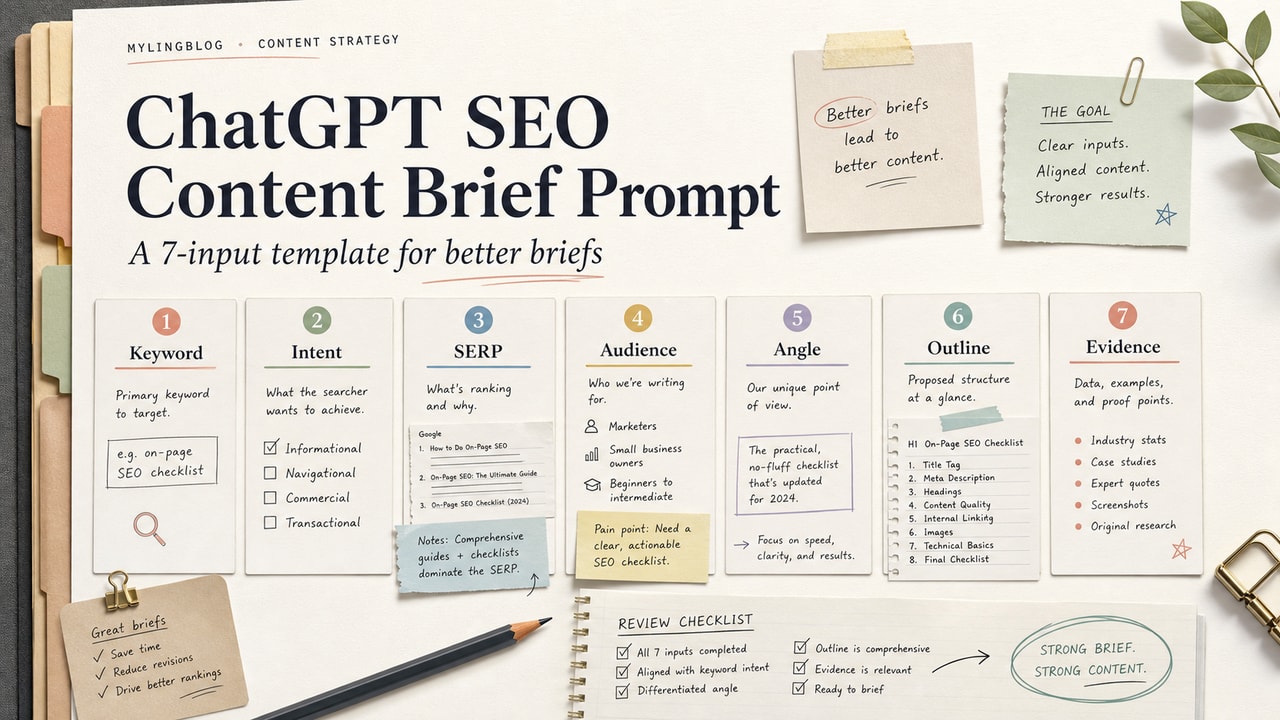
A weak AI-generated SEO brief usually has the same problem: it lists everything the article could cover and makes almost no editorial decisions. Writers then have to guess the angle, choose which sections matter, and decide which claims need proof. A better ChatGPT SEO content brief prompt keeps ChatGPT in a narrower role. It turns editor-supplied inputs into a usable brief, while the editor keeps control of angle, source judgment, internal links, and final approval.
Quick Answer
A strong ChatGPT SEO content brief prompt does not ask the model to invent a full strategy from one keyword. It gives ChatGPT seven inputs: primary keyword, search intent, target reader, site context, SERP observations, internal links, and the unique angle the editor has already chosen. The output should be a one-page editorial brief with a working title, meta draft, slug, intent note, angle, H2 outline, entities, FAQ questions, internal-link slots, external-source slots, and clear verification flags. The editor still owns the hard parts: checking whether the angle matches the site, whether the SERP notes are accurate, whether claims need sources, and whether the writer can draft from the brief without asking for missing decisions. Use the brief as a decision document, not as a substitute for editorial strategy.
What This Workflow Is
This is a workflow for turning a keyword and editor notes into a writer-ready SEO content brief. The prompt is useful because it forces the model to work from defined inputs instead of guessing what the article should be.
Definition you can quote: A ChatGPT SEO content brief prompt is a structured instruction that uses editor-provided keyword, intent, audience, SERP, link, and angle notes to create a concise article brief for a human writer.
Who This Workflow Is For
- Best for: solo bloggers, niche-site owners, freelance SEO writers, and small editorial teams that need repeatable briefs without a full SEO department.
- Also useful for: SaaS founders and operators who know the article angle but need help turning it into a brief.
- Not ideal for: medical, legal, financial, or safety-sensitive topics where a subject-matter expert must define the brief before any AI drafting happens.
Tools You Need
| Tool | Use it for | Decision note |
|---|---|---|
| ChatGPT | Generate the first brief from your inputs | Use it after the angle is chosen, not before |
| Claude | Alternative for longer notes or second-pass review | Useful when the brief includes more context |
| Google Search Console | Query patterns from your own site | Use real query data when refreshing old posts |
| Google helpful content guidance | Trust and usefulness guardrails | Use it to reject briefs that over-promise or lack reader value |
A paid AI tool is worth considering only if brief creation is a recurring bottleneck and your team is allowed to paste editorial notes into that tool. If you brief occasionally, start with the tool you already use.
Workflow Summary
| Step | Human input | AI output |
|---|---|---|
| Intent | Primary keyword and search intent | One-sentence intent note |
| Reader | Target reader and site context | Angle-aware brief language |
| SERP | Observed H1/H2 patterns from ranking pages | Outline that matches the query without copying competitors |
| Links | Approved internal articles and source needs | Mapped link slots with section placement |
| Review | Editor checks claims and fit | Keep, edit, reject, and verify notes |
Step-by-Step Workflow
- Choose the keyword and intent. Do not ask ChatGPT to choose the primary keyword. Start with the query you already decided to target, then write the likely intent in plain language.
- Write the reader and site context. Include who the article is for, what the site already covers, and what tone the writer should avoid.
- Collect SERP observations. Do a static/manual SERP review outside the model. Capture the titles, first major sections, and repeated reader questions. Do not paste copied competitor paragraphs.
- Pick the unique angle yourself. The angle is the editorial decision that prevents the brief from becoming a generic outline. If you cannot state the angle in one sentence, the article is not ready for AI briefing.
- Run the prompt. Paste the seven inputs and ask for the exact brief format below.
- Review the output as an editor. Keep the sections that serve the reader, edit vague headings, reject invented facts, and mark anything that needs source checking.
- Send the brief with a decision note. Add a two-line note telling the writer what to prioritize and what not to cover.
Copy-and-Paste Prompt
You are an SEO content editor preparing a brief for a human writer.
Do not invent facts, sources, rankings, pricing, or search volume.
Mark uncertain items with [verify with editor].

Inputs:
- Primary keyword: [paste]
- Search intent: [informational / commercial / comparison / transactional]
- Target reader: [one sentence]
- Site context and voice: [two to four sentences]
- SERP observations: [top titles, first H2s, repeated questions, no copied body text]
- Internal articles to consider: [3 to 6 URLs]
- Unique angle chosen by editor: [one sentence]

Output these sections only:
1. Working title and meta draft
2. Slug suggestion
3. Search intent in one sentence
4. Angle in one sentence
5. H2 outline with one required point per section
6. Entities and concepts to mention
7. FAQ questions
8. Internal link slots with target H2
9. External source slots with reason
10. Things this article must not do
11. Verification checklist for the editor
Example Input
Primary keyword: ai keyword clustering.
Search intent: informational workflow.
Target reader: niche blogger with a small archive and no paid SEO suite.
Site context: practical AI workflows for small teams; avoid broad claims and tool hype.
SERP observations: ranking pages explain clustering, list tools, and show simple grouping examples.
Internal articles: AI SEO workflow, AI SEO checklist, old-post update workflow.
Unique angle: cluster by writer effort and decision value, not only by topic similarity.
Example Output
Angle: Use AI to group keywords by writing effort, reader decision, and internal-link role so a small site can plan posts without a paid clustering tool.
H2 outline: What keyword clustering solves; when AI clustering is enough; four effort tiers; copy-paste prompt; example cluster; review checklist; FAQ.
Internal link slot: Under the review checklist, link to /posts/ai-seo-checklist with anchor text "AI SEO checklist."
Verification checklist: confirm keyword intent, remove unsupported time-saving claims, check tool links, and verify that each FAQ answers a real reader objection.
Tested Workflow Notes
The strongest briefs from this workflow have one visible trait: the editor's angle is present in every major section. Weak briefs hide the angle in the intro and then drift into a generic guide. During review, search the output for the angle sentence. If the outline would still make sense without it, rerun the prompt with a sharper input.
We also reject brief sections that ask the writer to prove claims the site cannot support. A brief should make fact-checking easier by naming source needs, not by smuggling in numbers, rankings, or tool claims that no one verified.
Workflow Artifact: Brief Review Scorecard
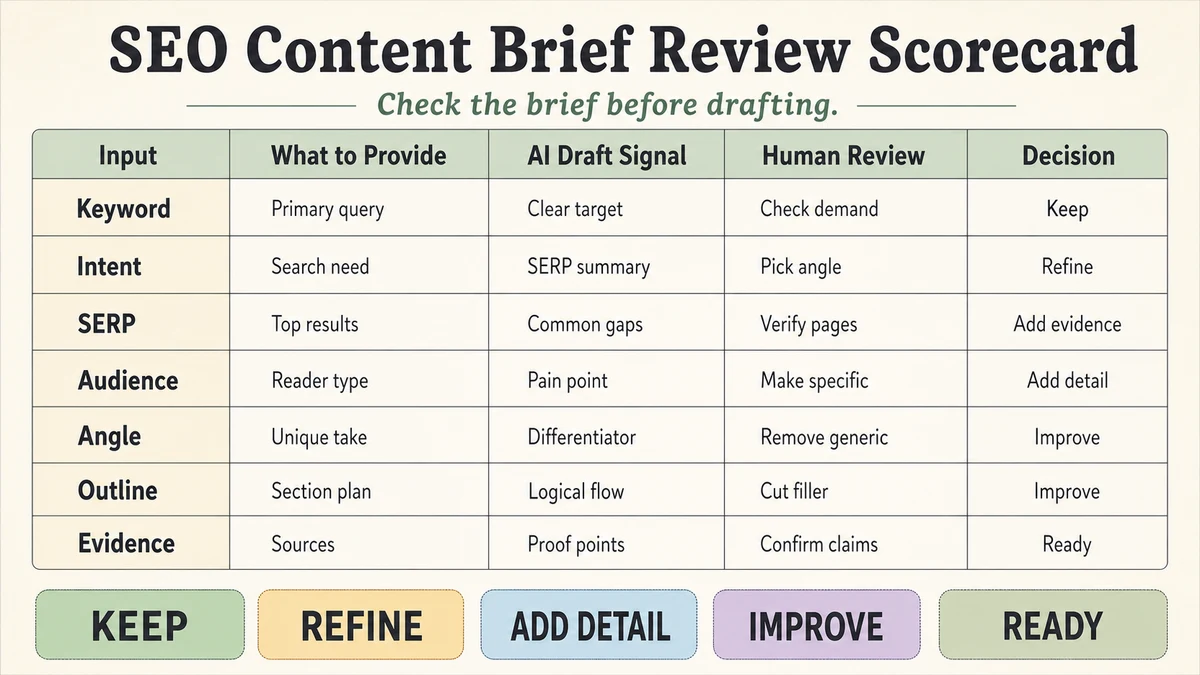
| Review check | Pass condition | If it fails |
|---|---|---|
| Angle | The angle changes the outline, not just the intro | Rewrite the angle and rerun |
| Intent | The section order matches the query type | Recheck SERP observations |
| Claims | No unsupported pricing, volume, ranking, or timing claims | Source, hedge, or remove |
| Links | Each link helps the writer answer a reader follow-up | Remove forced links |
Uniqueness Pass: What the Brief Must Add
Before sending the brief to a writer, run one more question: what will this article add that the current SERP does not already make obvious? If the answer is only "a complete guide," the brief is not specific enough. The unique angle has to change section order, examples, link choices, or the final recommendation.
| SERP already covers | Brief should add | Reject if ChatGPT suggests |
|---|---|---|
| Basic definitions | A decision rule for when the workflow is worth using | Another generic "what is" section |
| Tool lists | Why this site would choose or reject a tool for this reader | Unverified rankings or pricing claims |
| Step lists | An example input/output that shows the editor's judgment | Steps that could fit any keyword |
| FAQ answers | Questions tied to the reader's drafting risk | FAQs invented only to fill space |
This pass is where the brief becomes useful to a writer. It turns the unique angle from a slogan into instructions the writer can actually follow: what to emphasize, what to skip, and what must be verified before the draft moves forward.
Pitfalls We've Actually Hit
- Letting ChatGPT choose the angle. The result usually sounds like a generic complete guide. The editor should choose the angle before the model writes the brief.
- Pasting SERP notes without judgment. If competitors all repeat the same weak section, copying the pattern can preserve the weakness. Capture the pattern, then decide whether to keep it.
- Sending the brief without verification flags. Writers may treat every line as approved unless uncertain items are clearly marked.
Common Mistakes
- Briefing from a keyword only. This creates a generic outline with no site-specific value.
- Skipping internal links. The writer needs to know where the article fits in the content hub.
- Using exact pricing or tool limits without source checks. These claims change often and should usually be hedged or linked to official pages.
- Asking for too many entities. A short list of required concepts is more useful than a long list the writer ignores.
- Confusing an outline with a brief. A brief includes decisions, link slots, source needs, and things not to cover.
Tool Alternatives
| Need | Option | Trade-off |
|---|---|---|
| Long context review | Claude | Useful when the SERP notes and site context are long |
| Quick prompt iteration | ChatGPT | Good for drafting several brief variants quickly |
| Research-heavy brief | Perplexity or another source-first tool | Better when citations matter more than outline polish |
| Full SEO platform | Ahrefs, Semrush, SurferSEO, Frase, or MarketMuse | Consider only if you already use their data in planning |
FAQ
How long should an SEO content brief be?
Long enough to remove the main writing decisions, but short enough that the writer will actually use it. For most blog posts, a one-page brief with outline, angle, links, FAQ, and verification notes is enough.
Can ChatGPT create the brief from only a keyword?
It can generate text, but the result is usually too generic. Give it intent, reader, site context, SERP observations, internal links, and the angle you want the article to own.
Should the prompt include search volume?
Only if you have reliable data from your own tool or export. Do not ask ChatGPT to estimate search volume. If the number affects the brief, source it outside the model.
How is this different from an outline?
An outline names sections. A brief tells the writer why the article exists, what angle to defend, where to link, which claims need proof, and what not to cover.
Do writers still need to fact-check the brief?
Yes. The brief should make fact-checking easier, not remove it. Any item marked [verify with editor] should be checked before drafting or before publication.
Final Recommendation
Use this prompt when you already know the keyword and angle but need a repeatable way to turn them into a writer-ready brief. Do not use it to replace editorial strategy. The value is in forcing the right decisions into the brief before drafting starts.
For a broader publishing process, pair this prompt with the full AI SEO workflow, the AI SEO checklist, and the model-selection notes in ChatGPT vs Claude vs Gemini for SEO writing.