 Lingye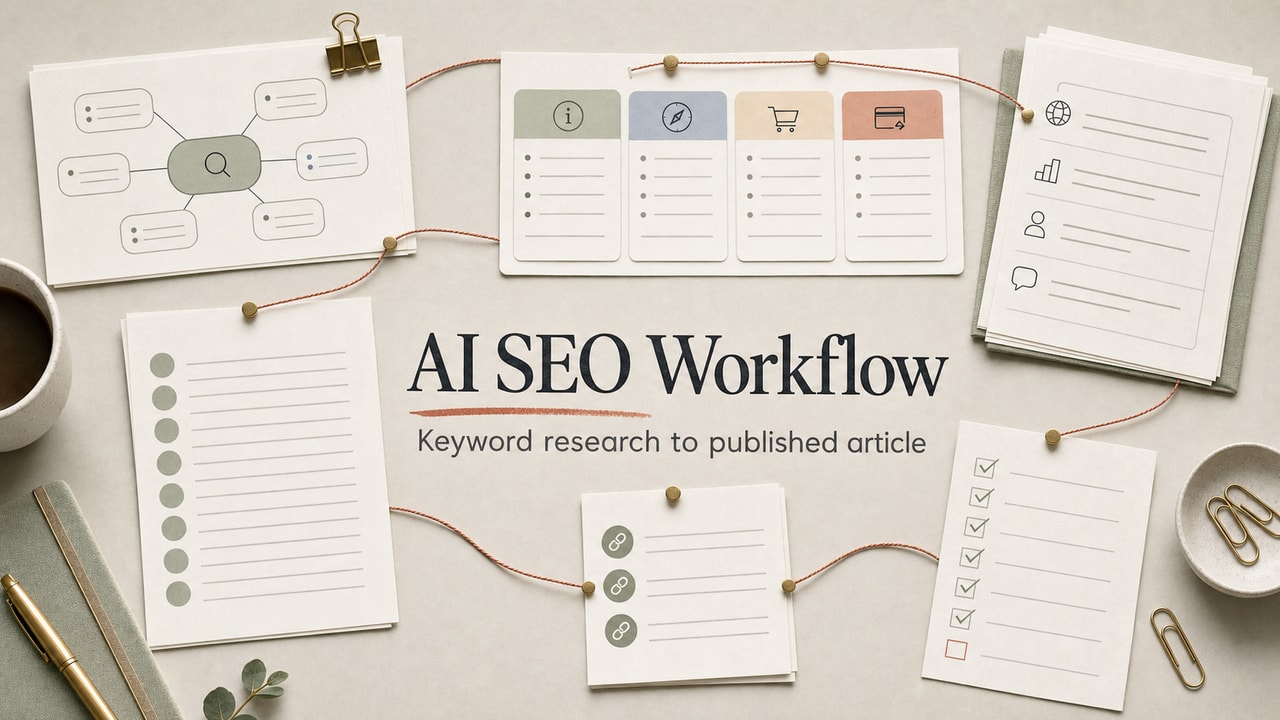
You can ask an AI tool for keywords and still end up with a thin article if the workflow has no human checkpoints. The AI SEO workflow below keeps the useful automation - clustering, brief drafting, metadata variants - but makes intent analysis, source review, and final recommendation manual decisions. That is the difference between a publishable workflow and a fast content factory.
Quick Answer
An AI SEO workflow is a seven-step editorial sequence: validate the keyword, read the search intent, build a brief, draft with AI, edit and fact-check, write metadata, and monitor Search Console after publishing. The practical decision is not which tool can write fastest; it is where you keep human judgment. Use AI for clustering, outlines, examples, and metadata variants, but keep SERP interpretation, source verification, internal-link choices, and the final recommendation manual. This workflow is best for bloggers, niche site owners, and small teams that need a repeatable content process before buying more tools or changing their editorial process. It is not a good fit for news, YMYL advice, or posts where the author's original experience is the whole value.
What This Workflow Is
An AI SEO workflow isn't a tool stack - it's a sequence. The point isn't to "let AI write your blog." It's to delete the parts of writing that are mechanical (keyword grouping, intent analysis, outline scaffolding, meta-description rewriting) and keep the parts that actually need a human: the angle, the original example, the editorial judgment about what to leave out.
A definition you can quote: an AI SEO workflow is a repeatable process that uses AI tools to research keywords, create content briefs, draft articles, optimize metadata, and improve existing content - always with human review. That's the structure Google has explicitly said is fine to use, as long as the human-review part is real (see Google's official statement on AI-generated content).
Who This Workflow Is For
- Best for: Bloggers, niche site owners, content marketers, and PMs who own a content surface (docs, help center, marketing blog).
- Also useful for: Solopreneurs running a one-person editorial calendar.
- Not ideal for: News sites (the cycle is too fast for batch workflows), pure thought-leadership pieces (AI dilutes original voice), or YMYL topics like medical, legal, or financial advice (regulatory risk is too high for AI-assisted drafting).
Tools You Need
Use this as a decision guide, not a fixed tool stack. Plan names, model limits, and pricing change, so keep assumptions separate from the article copy.
| Tool | Use | Checkpoint |
|---|---|---|
| AI assistant | Draft briefs, outlines, and section passes | OpenAI prompting guide |
| Search Console or keyword notes | Ground the article in real queries | Google Search Console |
| Google Search Central | Check people-first content boundaries | Helpful content guidance |
Workflow Summary
The full pipeline is seven steps, but the reader value comes from three checkpoints: SERP intent, source trust, and post-publish learning. AI can speed up the middle of the workflow; it should not decide the angle, the claims, or the final recommendation.
| Stage | AI can help with | Human decision to keep |
|---|---|---|
| Keyword and intent | Cluster phrases and summarize patterns | Pick one search intent and reject weak angles |
| Brief and draft | Turn notes into H2s, examples, and first-pass prose | Add the original example, source rules, and reader promise |
| Edit and publish | Suggest metadata and FAQ variants | Verify claims, trim generic text, and choose the final CTA |
| Refresh | Summarize Search Console changes | Decide whether to update, merge, or leave the post alone |
- Research and validate the keyword.
- Analyze search intent for the top ranking pages.
- Build a content brief.
- Draft the article with AI assistance.
- Edit, fact-check, and humanize.
- Write metadata and FAQ.
- Publish, monitor, and refresh only when the evidence supports it.
Step-by-Step Workflow
- Validate one keyword. Confirm the query has a clear reader problem and is not just a phrase you want to rank for.
- Read search intent manually. Note the format, repeated subtopics, and missing angle before asking AI for help.
- Build the brief. Give the model the reader, promise, internal links, source requirements, and sections to avoid.
- Draft section by section. Use AI for a first pass, then rewrite generic openings, unsupported claims, and weak examples.
- Fact-check before polish. Extract claims about tools, pricing, Google, models, or outcomes and verify, hedge, or remove them.
- Write metadata last. Only write the title and meta description after the article promise is stable.
- Monitor after publishing. Use Search Console to decide whether to refresh, merge, or leave the page alone.
Copy-and-Paste Prompt
You are an SEO writing assistant for MyLing Workflow Lab.

Brief:
- Primary keyword: [keyword]
- Secondary keywords: [keyword 1], [keyword 2], [keyword 3]
- Target reader: [creator / blogger / PM / solopreneur]
- Article goal: [rank for X / drive email signups]
- Word count target: 1,500-2,000 words

Constraints:
- Write in clear, direct English. Avoid marketing fluff.
- Use H2/H3 structure with descriptive headings.
- Include a 3-5 sentence "Quick Answer" near the top that stands alone.
- Include at least one comparison table.
- Include a copy-and-paste prompt for the reader.
- Include 5 FAQ questions at the end.
- Do not invent statistics. If you don't have data, say "approximately" or skip it.
- Do not invent product features. If unsure, write "check the official documentation."

Output: full Markdown draft.
Example Input
Use a narrow input so the AI tool has enough constraints to produce a useful brief instead of a generic SEO outline.
Primary keyword: ai seo workflow
Target reader: solo blogger with 20 older posts and limited editing time
Business goal: choose a repeatable refresh workflow before paying for another SEO tool
Known source constraints: use Google Search Central for AI content guidance and Search Console for performance checks
Original angle to include: AI can cluster and draft, but humans must decide search intent and remove unsupported claims
Internal links to consider: /posts/ai-writing-workflow-for-bloggers, /posts/ai-prompt-templates, /categories/ai-seo
Example Output
Run the prompt with primary keyword ai keyword clustering and target reader blogger. A clean sample excerpt can look like this:
AI keyword clustering is the process of using a language model to group related search terms into topic clusters that share the same search intent, so you can plan one article per intent cluster instead of one article per keyword. Done well, it turns a messy keyword list into an editorial map, but the final cluster decision still needs human review.
The opening sentence is a complete definition. That makes the section easier for readers and retrieval systems to parse before the workflow details begin.
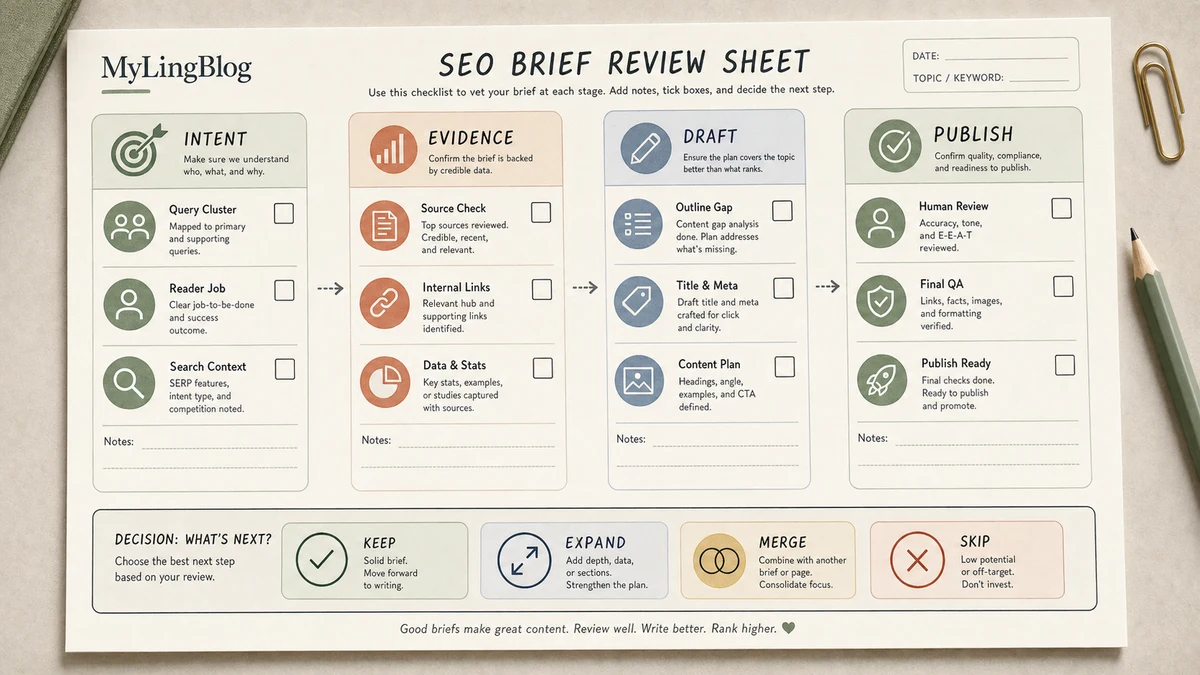
Workflow Artifact: SEO Brief Review Table
This is a sample editorial artifact, not first-party ranking data. Use it before drafting to decide whether an AI-generated SEO brief is specific enough to publish from.
| Brief item | Review question | Pass rule | Decision |
|---|---|---|---|
| Primary keyword: ai seo workflow | Does the brief serve one search intent? | Workflow article, not a general tool list | Keep |
| Source requirement: Google guidance plus Search Console | Are mutable claims tied to sources? | Source before drafting or remove the claim | Revise |
| Original-value slot: example input and avoid note | Would this survive an AI-summary comparison? | Concrete artifact or reject the section | Keep |
How to read it: the table forces the brief to show intent, source discipline, and original value before the article draft begins. If any row is vague, the prompt is not ready yet.
Tested Workflow Notes
- Input type: A keyword, three competitor notes, and one existing post that needed a refresh.
- Tool used: ChatGPT and Claude were useful as drafting assistants; plan and model access should be checked on the official pricing pages before standardizing the workflow.
- Best result: AI was strongest at turning messy SERP notes into a brief and FAQ candidates.
- What failed: The first draft over-expanded definition sections and treated every keyword as a new article opportunity.
- Manual edits still needed: We still had to choose the search intent, verify mutable claims, and decide which internal links helped the reader's next step.
Pitfalls We've Actually Hit
- Letting keyword clusters become article clusters. AI will often split every phrase into a separate post. We now merge keywords when the reader decision is the same.
- Accepting unsupported metrics because they make the draft feel specific. If a number cannot be traced to a primary source or first-party Search Console data, it gets removed or hedged.
- Refreshing the wrong thing. A weak title needs metadata work; a thin section needs examples; a mismatched article may need merging. Treating every problem as a rewrite wastes time.
Common Mistakes
- Skipping search-intent analysis. This is the fastest way to publish a page that answers the wrong reader problem.
- Letting AI invent statistics. If you did not provide the number or verify it from a source, remove it or clearly hedge it.
- Generating metadata after the article is locked. Title and description options should be drafted while the brief is still flexible.
- Adding FAQ only for search engines. FAQ should answer real reader objections, not pad the page.
- Refreshing without diagnosis. Check whether the problem is intent, depth, freshness, title fit, or internal links before rewriting.
Tool Alternatives
| If you cannot use... | Try... | Decision tradeoff |
|---|---|---|
| ChatGPT paid plan | Claude, Gemini, or the free plan available to you | Stay free while testing the workflow; upgrade only when limits slow actual publishing. |
| Claude paid plan | ChatGPT plus a stricter editing checklist | You may need more manual voice cleanup, but the workflow still works. |
| Dedicated SEO suite | Search Console, Google Trends, and manual SERP review | Less data, but better discipline for small sites that need focused edits. |
| Notion or Airtable | Google Sheets | Less elegant, but easier for a solo blogger to maintain weekly. |
The commercial decision is simple: pay for tools only after your manual workflow is repeatable. A paid stack will not fix vague briefs, unverified facts, or missing original examples.
Editorial Decision Example: Refreshing a Weak Post
Suppose an older post gets impressions for ai content brief template, but the page mostly defines what a brief is. The better edit is not a full rewrite; it is a practical input/output example, a brief template, and one related prompt-template link. Keep the slug, intent, and working internal links unless there is a clear mismatch.
FAQ
How long does an AI SEO workflow take per article?
It depends on the source load and edit depth. Treat it as blocks: intent review, brief, draft, fact-check, and final edit.
Can AI do keyword research for me?
It can organize keyword notes, but it should not invent volume, difficulty, or search demand. Use real data where possible.
Should AI write the whole SEO article?
Drafting section by section is safer. It keeps examples, claims, and voice easier to review.
What part should stay human-owned?
Intent fit, source trust, final examples, and the publish decision should stay with the editor.
What is the biggest risk?
A smooth article that answers the wrong problem. Fix that by reviewing intent before drafting.
Final Recommendation
If you take only one thing from this workflow: do steps 2 and 5 - intent analysis and human review - yourself, no matter what. AI can support keyword grouping, brief drafting, metadata variants, and refresh ideas. It should not own the reader promise, source trust, or final recommendation.
Start with one article this week. Use the prompt above, record where the draft improves the workflow, and mark the points where human review changed the result. That review record is what turns AI-assisted SEO from a fast drafting trick into a repeatable editorial process.