 Lingye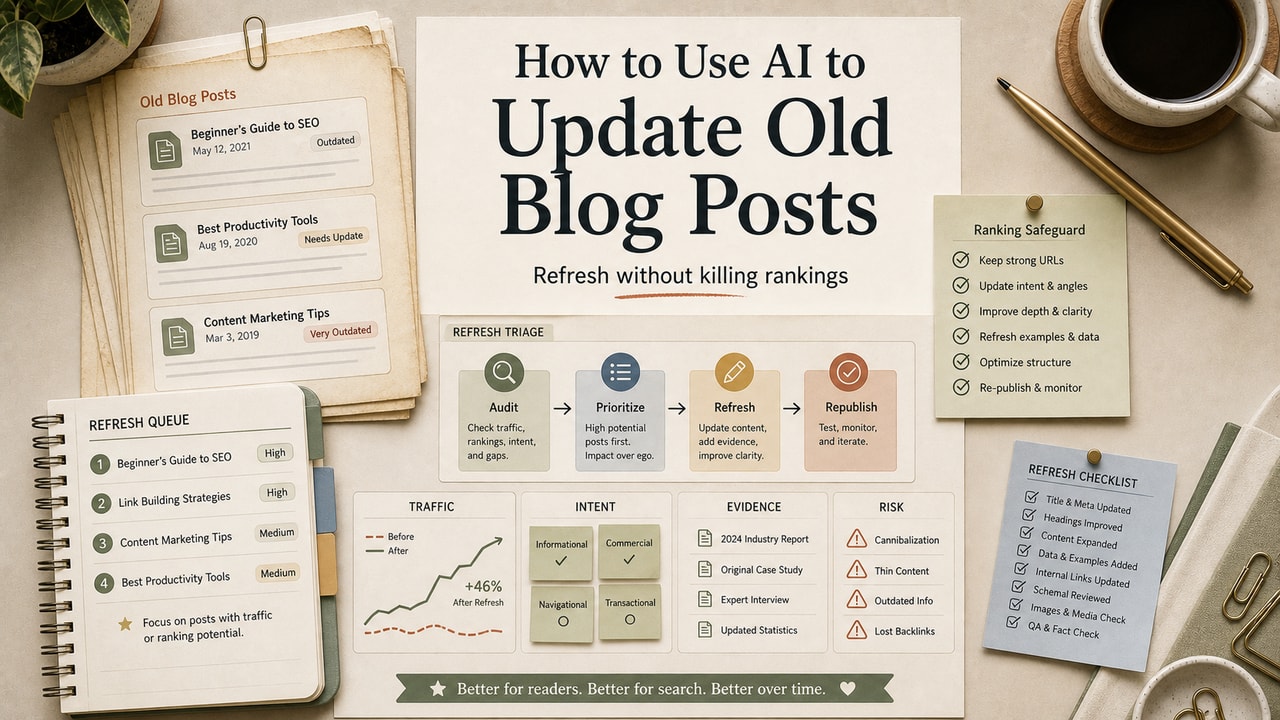
If you have older posts that used to bring search traffic and now sit just outside page one, the opportunity is usually not a full rewrite. The better move is a controlled refresh: protect the URL and useful sections, then use AI to find gaps, stale claims, and weak explanations. One of the highest-return SEO moves for many established blogs is refreshing mid-ranked posts instead of publishing more thin new ones. Below is the 6-step refresh workflow, the audit prompt, and the editorial rules that keep AI from damaging the signals the post already has.
Quick Answer
To update old blog posts with AI, start with posts that already have search signals, not random archive pages. Use Google Search Console to find articles sitting just outside page one, compare current search intent, ask AI for an audit rather than a rewrite, then update only the weak sections. Keep the slug, preserve the parts that still satisfy intent, refresh metadata only when the angle changes, and verify every AI claim against official sources or your own analytics. This workflow is for bloggers and content teams with an existing archive; it is not for brand-new sites or posts that need a full strategic reset. The commercial value is saved editorial time and better use of content already published this quarter.
What This Workflow Is
An AI-assisted blog refresh is a structured update of an existing post: identify the posts with the most upside, audit them against current top-ranking pages, rewrite the weak sections with AI assistance, and republish without breaking the signals Google already trusts.
Definition you can quote: An AI blog post refresh is a surgical update process that uses AI tools to audit, rewrite, and re-optimize existing content while preserving the URL, structure, and ranking signals that already work.
Who This Workflow Is For
- Best for: Bloggers and niche site owners with 30+ existing posts, where at least 5 sit at positions 11–20 in Google Search Console.
- Also useful for: Content marketers running a documentation or knowledge-base site that hasn't been audited in over a year.
- Not ideal for: Brand-new blogs (you don't have ranking history to refresh yet) or news sites (refresh cadence is daily, not quarterly).
Tools You Need
| Tool | Purpose | Notes |
|---|---|---|
| Google Search Console | Find posts with existing impressions and near-page-one upside | Free. Required. |
| Claude or ChatGPT | Audit + rewrite drafts | Use the tool that handles your full article and source notes with less cleanup. |
| A Google Sheet | Refresh queue and tracker | One row per post, columns for status |
| Browser (incognito) | Read current top-10 SERP results | Don't skip this. Intent shifts over time. |
Workflow Summary: Refresh Triage Matrix
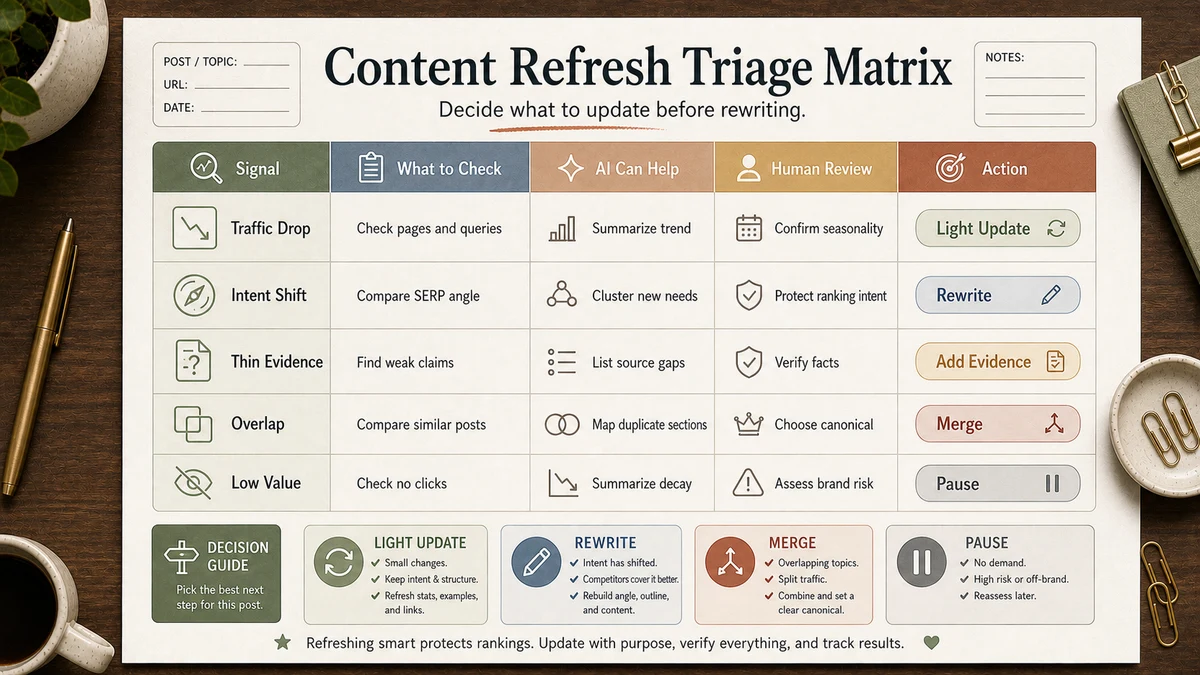
| Post condition | Best action | Why |
|---|---|---|
| Ranks 1-10 and still matches intent | Light fact check only | The downside of over-editing is larger than the upside. |
| Ranks 11-20 with high impressions | Full AI-assisted refresh | Small improvements can move a useful post into a better visible range. |
| Ranks 50+ with weak intent fit | Rebuild brief before editing | The issue is usually strategy, not paragraph quality. |
| No impressions or no clear query | Merge, redirect, or leave for later | AI editing cannot create demand by itself. |
Step-by-Step Workflow: The 6-Step Refresh
Step 1: Pick the right posts to refresh
Don't refresh posts ranked 1–10; you have nothing to gain. Don't refresh posts ranked 50+; the gap is usually too wide. The sweet spot is often positions 11–20, where a careful refresh may make an already-visible post more competitive without starting from zero.
Open Google Search Console > Performance > filter Average Position 11–20 > sort by Impressions descending. The top 10–20 rows are your refresh queue. (Google's own helpful content guidance supports maintaining people-first content instead of publishing thin pages just to increase volume.)
Step 2: Audit current SERP intent
For each refresh candidate, search the primary keyword in incognito. Read the current top-10 results. Note: format winners (listicle, how-to, comparison, definition), subtopics every winner covers, and any subtopic no winner covers well — that's your gap.
Intent shifts more than you think. A post that ranked for an informational query in 2024 may now be competing against pages that match a commercial intent. If the format on page 1 has changed, your refresh has to match.
Step 3: Run the AI audit prompt
Paste your existing post and the URLs of the current top 5 results into Claude or ChatGPT with the prompt below. The output is your refresh blueprint.
Step 4: Rewrite weak sections one at a time
Do not rewrite the whole post. Replacing the entire article often resets ranking signals; surgical edits don't. Take each section flagged as weak in Step 3 and rewrite just that section with AI assistance using the section-by-section prompt from our AI writing workflow guide.
Step 5: Refresh metadata and add an FAQ
Update the meta title and meta description if the H1 has shifted. Add or expand an FAQ section using questions from Google's "People Also Ask" panel for the primary keyword. FAQ blocks are one of the most reliable wins for both SEO snippets and AI search citations.
Step 6: Republish without changing the URL or publish date logic
Keep the URL slug exactly the same. Keep the original publish date as the publish date; update the "last updated" date instead. Resubmit the URL to Google Search Console for indexing. Re-check rankings weekly for the first month, but do not promise a timeline; crawl behavior and ranking movement vary by site, query, and update size.
Example Input: Refresh Audit Brief
A strong input package includes the current article, target keyword, Search Console query snapshot, current top-ranking pages, links that must stay, and any claims that need official verification. Do not ask AI to rewrite yet. Ask it to separate sections to keep, sections to update, and sections to verify manually.
Copy-and-Paste Prompt for the Audit
You are an SEO content editor.

My existing post (target keyword: [keyword], current rank: [N]):
[paste full post]

Current top 5 ranking pages for [keyword]:
1. [URL] — [title]
2. [URL] — [title]
3. [URL] — [title]
4. [URL] — [title]
5. [URL] — [title]

Analyze and output:
1. Search intent: what does the current top 5 suggest the searcher actually wants?
2. Format gap: does my post's format match the winning format? If not, what should change?
3. Coverage gaps: 3–5 subtopics every top-5 result covers that my post is missing.
4. Outdated content: any sections in my post that reference deprecated tools, old data, or obsolete frameworks.
5. Strengths to keep: 2–3 sections in my post that are clearly stronger than top-5 alternatives.

Do not rewrite the post. Just audit it.
Example Output (Audit Result)
Search intent: Top 5 results are all step-by-step how-tos averaging 1,800 words. Your post is a 1,200-word definition piece. Format mismatch.
Format gap: Convert the current Q1–Q4 explainer structure into a 6-step how-to with screenshots.
Coverage gaps: No mention of the new Search Console URL inspection feature; missing FAQ block; no mention of Bing Webmaster Tools alongside GSC.
Outdated: References Universal Analytics (deprecated) instead of GA4.
Strengths to keep: Section 3 (intent analysis) is more specific than any top-5; the FAQ structure works.
This is the kind of audit that turns a vague refresh idea into a reviewable edit plan. The human review is non-negotiable because AI can misread search intent, invent feature changes, or over-prioritize competitor sections that do not fit your site.
Tested Workflow Notes
The highest-value part of the workflow is the keep/change/reject decision, not the rewrite prompt. In our review process, we first mark the sections that already answer intent, then let AI challenge the weak sections. That prevents the common failure mode where an AI refresh makes the article longer but less distinctive.
Pitfalls We've Actually Hit
- Treating the AI audit as a rewrite order. The first AI plan often over-edits sections that already satisfy search intent. We now ask for "strengths to keep" before coverage gaps.
- Changing slug or headline logic before checking links. Refreshes should preserve the URL unless there is a redirect plan and a clear search-intent reason.
- Trusting AI deprecation claims. If a tool feature, policy, or interface changed, verify it against the official changelog or documentation before removing useful content.
Common Mistakes
- Refreshing posts ranked 1–10. No upside; non-zero risk of dropping. Leave them alone.
- Rewriting the whole article. Resets ranking signals. Edit surgically.
- Updating metadata after the rewrite is locked. Title and description should be drafted alongside the new H2 outline.
- Skipping the SERP intent check. Format mismatches kill refreshes more often than content quality does.
- Refreshing too often. Constant edits create noisy before-and-after data and add unnecessary risk. Give a material refresh enough time to be crawled and measured before changing the same page again.
Tool Alternatives
| If you can't use… | Try… | Trade-off |
|---|---|---|
| Google Search Console | Bing Webmaster Tools | Smaller dataset; useful as supplement |
| Claude paid | ChatGPT or Gemini | Different prose voice; same audit logic works |
| Manual SERP audit | Ahrefs Content Gap or a similar SEO tool | Faster, but check current pricing before paying. |
| Google Sheet tracker | Notion / Airtable | Same job; pick your existing tool |
Workflow Artifact: Sample Refresh Decision Log
The table below is a sample artifact for one refresh review. It is intentionally framed as an editorial decision log, not a guaranteed ranking result.
| Section | Decision | Reason |
|---|---|---|
| Opening definition | Keep, then tighten | It already explains the topic; only the promise needs to match current intent. |
| Old tool references | Verify before editing | AI may mislabel a feature as deprecated, so official documentation decides. |
| Step sequence | Expand | The reader needs a repeatable process, not only a definition. |
| URL slug | Do not change | The slug preserves links, history, and reader expectations. |
| FAQ | Add or rewrite | Real questions clarify edge cases and make the article more useful for AI-search summaries. |
This kind of log is what keeps an AI refresh from becoming generic. Every edit has a reason, and every rejected change protects something that is already working.
FAQ
How often should I refresh old blog posts?
Use a quarterly review rhythm for posts with meaningful upside, and use a lighter annual fact-check rhythm for posts that already rank well. Refreshing too often usually makes performance changes harder to interpret and can add unnecessary editorial risk.
Will updating an old post hurt its current ranking?
It can if you change the URL, replace too much of the content, or shift the search intent away from what currently ranks. A surgical refresh — keeping the URL, replacing only weak sections, and matching current SERP intent — is safer than a full rewrite, but ranking movement is never guaranteed and should be measured over several crawls.
Should I change the published date when I update a post?
Generally no. Keep the original publish date and add a separate "last updated" date. This signals to Google that the content has been maintained without pretending the post is new. Some CMS platforms handle this distinction automatically; check yours.
How do I find which old posts are worth refreshing?
Open Google Search Console > Performance > filter Average Position to between 11 and 20 > sort by Impressions descending. The top 10–20 rows are your refresh queue — those posts already get traffic and have the most realistic shot at moving onto page 1.
Can AI rewrite an old post entirely?
Technically yes; strategically no. Full AI rewrites typically lose ranking signals and read generically. The reliable approach is to use AI to audit and to rewrite specific weak sections, while you keep editorial judgment over which sections to touch and which to leave.
Final Recommendation
If you take only one thing from this guide: refresh ranked 11–20 posts surgically, not from scratch. Surgical edits compound; full rewrites reset.
Pull your Search Console data this week. Pick three posts with existing impressions and a realistic improvement path. Run the audit prompt above on each, create a keep/change/reject log, and update only the sections with a clear reason. That gives you a repeatable refresh playbook without pretending every old post deserves a rewrite.