 Lingye
A quiet traffic drop feels different when the page above you is not a polished publisher. It is a messy Reddit thread: half strong opinions, half side notes, and one comment that answers the question better than your 2,000-word article. That is the moment to pause before rewriting. The SERP may not be asking for a better encyclopedia page. It may be asking for lived friction.
Quick Answer
When Reddit is outranking your site, do not start by copying forum threads or publishing a louder version of the same article. Start by diagnosing why the SERP prefers discussion: the query may need first-hand experience, unresolved edge cases, recent user language, or a comparison that your page skipped. This Reddit outranking workflow helps you classify the keyword, choose a rewrite, community-participation, or pivot path, and rebuild the article around evidence a generic answer cannot provide. It is for bloggers, niche-site owners, and content leads whose informational posts are slipping under forum results. It is not for spam, account farming, or guaranteed recovery promises.
What This Workflow Is
A forum SERP recovery workflow is a repeatable way to decide whether a Reddit-heavy result page deserves a rewrite, a new article, a community answer, or a graceful pivot. It treats the forum result as evidence, not as an enemy. If a thread ranks because people want current opinions, edge cases, and risk stories, a neutral "complete guide" may keep losing even after you add more words.
Google's own AI features guidance says the same SEO basics still matter for AI Overviews and AI Mode: crawlable pages, text that can be understood, helpful content, internal links, and structured data that matches the visible page. That matters here because a forum-heavy SERP is often a signal that the current top answers satisfy a subquestion your page does not.
The workflow below gives you a clean diagnosis before you spend another week editing. You classify the query, map what the forum result provides, add your own experience-backed artifact, and decide when the keyword is no longer worth chasing.
Who This Workflow Is For
- Best for: bloggers, niche-site owners, and content teams whose articles dropped under Reddit, Quora-style forums, community threads, or support discussions.
- Also useful for: SEO editors reviewing content decay, AI-search visibility, and pages that still rank but no longer win clicks.
- Not ideal for: anyone trying to seed fake forum posts, buy accounts, or turn a community into a link scheme.
The reader decision is simple: should you fight for the same query, reshape the article around first-hand evidence, or move that effort to a query where an independent page can still win?
Tools You Need
| Tool | What it does | Use it for |
|---|---|---|
| Search Console | Shows queries, impressions, and clicks for your pages | Find whether the drop is query-specific or page-wide |
| Manual SERP notes | A short spreadsheet or document | Record whether the top results are forums, official pages, videos, or expert articles |
| Google helpful-content guidance | Defines people-first content direction | Check whether your article actually helps beyond a summary |
| Source log | A small table in your article workflow | Separate official facts from forum pain points and editorial judgment |
| One drafting assistant | Any current text model you already use | Cluster forum objections and create a rewrite plan, with human review |
You do not need a paid SEO suite to run the first pass. Paid SEO software can help with rank tracking, content decay reports, and competitor discovery, but the core question is editorial: does the query want a structured expert answer, or does it want unresolved human experience?
Workflow Summary
Treat the forum result as a search-intent clue, then choose one of four responses. The wrong response is to write a longer article with the same missing proof. The right response depends on what the forum page is doing for searchers.
| SERP signal | What it usually means | Best response |
|---|---|---|
| Reddit thread has many specific objections | Readers want real-use edge cases | Add a decision matrix, "what failed" section, and source-backed answers |
| Forum thread is recent and your article is old | Freshness or policy changed | Update facts, add a current source log, and note what changed |
| Forum result answers a narrow pain point | Your article is too broad | Create a tighter support article or rewrite the opening around the pain |
| Forum results dominate every top position | The query may be discussion-first | Pivot to a comparison, checklist, or adjacent long-tail query |
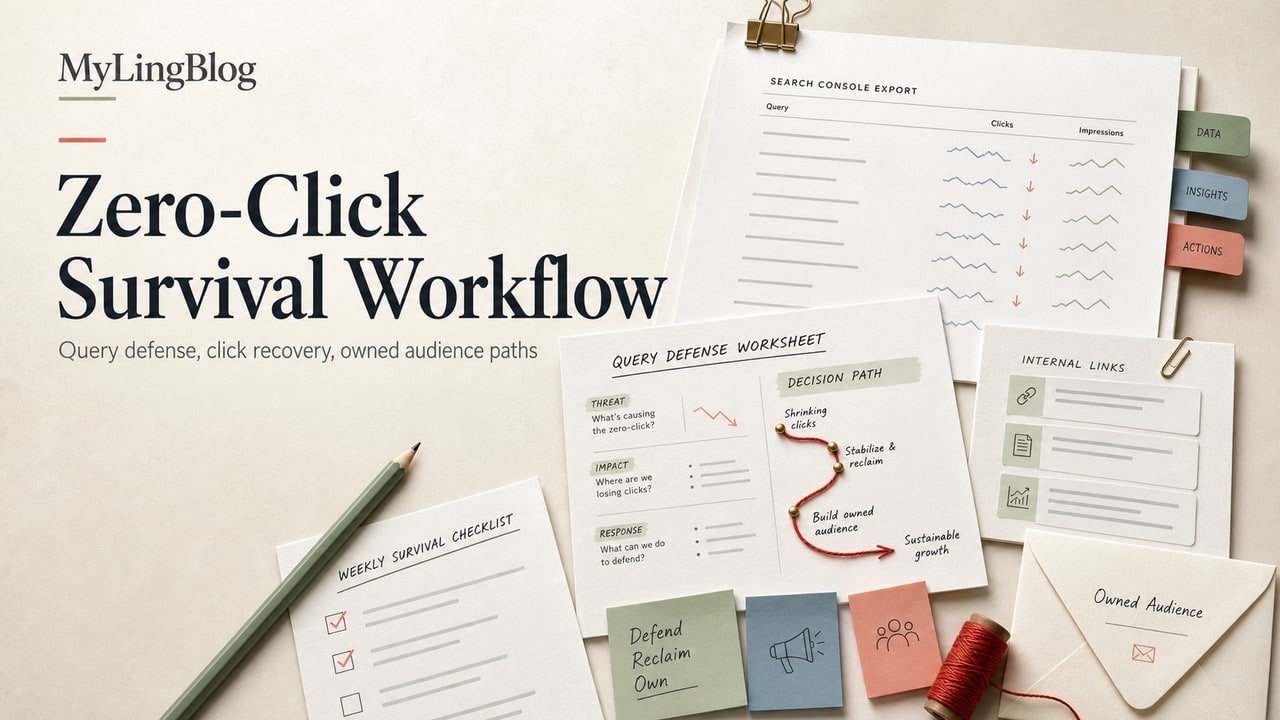
| AI answer summarizes the issue above both sites | Click value may be lower | Build a stronger internal-link funnel and owned-audience next step |
Recent coverage of "sloptimization" in The Atlantic shows why this needs restraint. Search and AI-answer systems are under pressure from brand mentions and community manipulation. A recovery workflow should not copy those incentives. It should help you publish the page a real reader would bookmark after reading the thread.
Step-by-Step Workflow
- Save the query set, not only the keyword. Pull the exact query that dropped, plus 5-10 close variants: "why," "vs," "is it worth it," "problem," "alternative," and "what to do" versions.
- Classify the top results. Mark each top result as forum discussion, official source, expert article, product page, video, or AI answer. Do not judge yet.
- Read the forum result for unmet needs. Look for objections, missing context, tool limits, failure stories, and language repeated by several users.
- Compare your article against those needs. Highlight where your page gives a direct answer, where it only summarizes, and where it avoids the hard decision.
- Choose a response path. Rewrite, split, merge, participate ethically, or pivot. Do not combine all five unless the page is a pillar.
- Add one original artifact. Use a source log, before/after table, decision matrix, checklist, or prompt chain. This is the part a generic answer usually lacks.
- Rebuild the first 300 words. Name the exact pain, give the quick recommendation, and show why your page is different from the forum thread.
- Verify links and claims. Use official sources for facts, not Reddit comments. Use forum language only as intent evidence.
- Measure after recrawl. Track query impressions, click-through rate, and which internal link readers choose next.
Google's AI Mode announcement frames AI search as a place for multi-part exploration and comparisons. That is the clue: a recovery article should answer the branches behind the query, not just repeat the head term.
Copy-and-Paste Prompt
Use this after you collect the SERP notes yourself. Do not paste private customer data or full forum comments if they contain personal details.
You are helping me diagnose a forum-dominated search result.

Primary query:
[paste query]

My current article:
[paste title, slug, short summary, and the first 300 words]

SERP notes:
- Result 1 type:
- Result 2 type:
- Result 3 type:
- Forum thread themes:
- Repeated reader objections:
- Official facts I must verify:

Task:
1. Classify the search intent as discussion-first, expert-answer, product-decision, troubleshooting, or mixed.
2. List what the forum result provides that my article does not.
3. Recommend one response: rewrite, split, merge, ethical community participation, or pivot.
4. Draft a new opening angle in 80-120 words.
5. Suggest one original artifact: checklist, matrix, source log, before/after table, or prompt chain.
6. Flag any claim that needs an official source before publication.

Rules:
- Do not invent data.
- Do not recommend fake forum participation.
- Do not use forum comments as factual sources.
- Prioritize reader value over ranking tactics.
Example Input
| Field | Example |
|---|---|
| Primary query | "reddit outranking my site" |
| Current article angle | A broad AI SEO checklist for old blog posts |
| Top SERP pattern | Two Reddit threads, one official help page, one niche SEO article |
| Forum themes | "My article is too polished," "Google wants real experience," "I do not know whether to rewrite or abandon it" |
| Current page gap | The article explains content updates but lacks a forum-specific decision path |
| Business decision | Spend one editing sprint on recovery or move to a more commercial long-tail query |
This input is intentionally small. If you cannot explain the SERP in six rows, you probably do not understand why the forum result is winning yet.
Example Output
| Diagnosis item | Output |
|---|---|
| Search intent class | Mixed: troubleshooting plus editorial decision |
| What the forum provides | Recent language, anxiety, edge cases, and examples of failed rewrites |
| Recommended response | Rewrite the article opening and add a SERP response matrix; do not create a separate article unless the query group is large |
| Original artifact | A matrix that maps forum signal to rewrite, split, participate, or pivot |
| Claims to verify | Any claim about Google AI features, AI Mode, Search Console reporting, or a named platform's ranking changes |
| Stop-loss rule | If top results remain mostly forums across 8-10 close variants, target a narrower query where a structured answer is clearly useful |
The useful part is not the model's prose. The useful part is the forced choice. A content team can waste days adding definitions; the matrix tells you whether the page needs evidence, a tighter query, or a different target.
Tested Workflow Notes
- Input type: a five-query SERP note set, one current planning topic, and internal article inventory from the live site.
- Tool used: manual web/source review, Search Console-style query framing, and a current text assistant for clustering the objections.
- Best result: the workflow separated three different jobs: source verification, reader-pain mapping, and rewrite choice.
- What failed: the first pass treated every forum result as a weak-page signal; some queries are simply discussion-first.
- Manual edits still needed: a human editor must decide whether the article has enough first-hand evidence to deserve the query.
We used this as an editorial dry run for the article you are reading, not as a claim that one rewrite restored traffic. The pattern was useful because it stopped the obvious mistake: writing another generic "how to rank" section when the real query is fear, not theory.
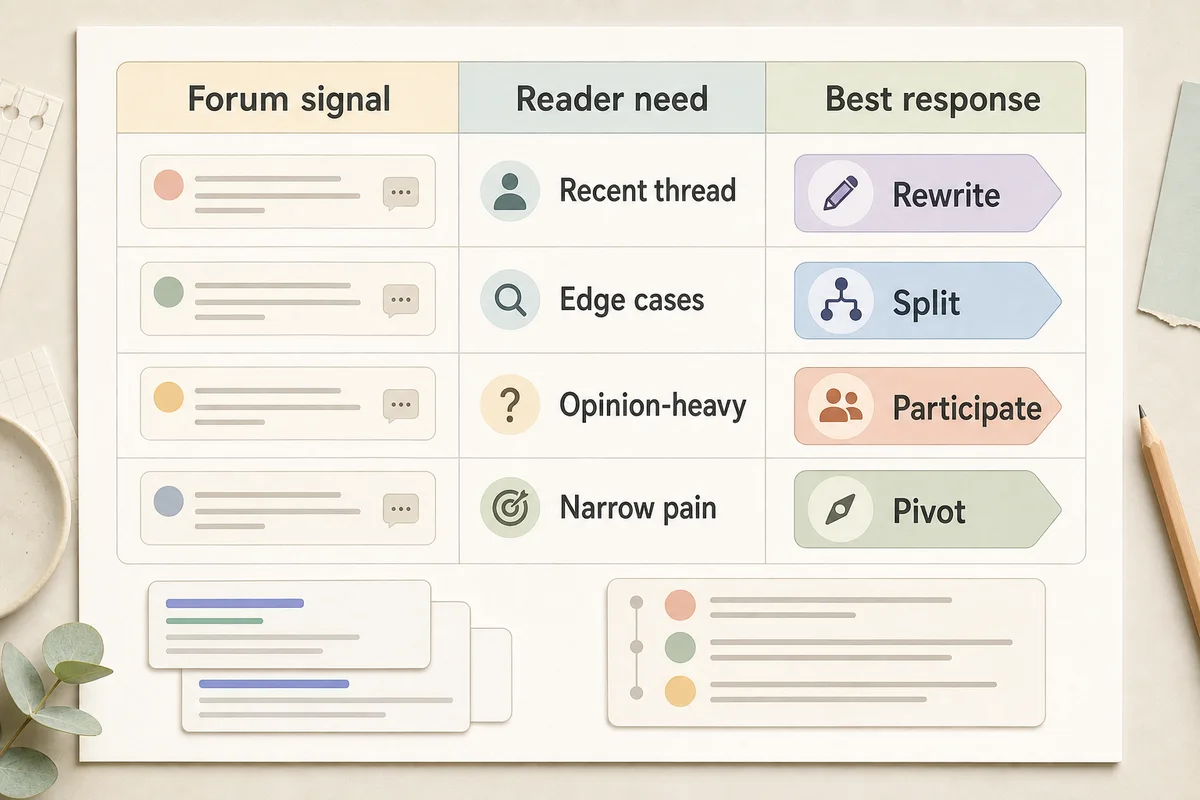
SERP Response Matrix
Use this matrix before you touch the article body. It keeps the rewrite from becoming a random pile of forum-inspired additions.
| Forum-heavy signal | Reader need | Add to your page | Do not do |
|---|---|---|---|
| Many comments ask "does this still work?" | Current proof | Source log with checked dates and official links | Quote forum comments as facts |
| Comments compare several options | Decision support | Comparison table with who should skip each option | Create a fake "best" ranking |
| Users share failures | Risk control | Pitfalls section with what to avoid | Promise recovery |
| Thread is mostly opinion | Lived context | Editorial notes and scenario-based advice | Pretend you tested every case |
| Thread is narrow but your page is broad | Specific answer | Rewrite title, meta, and first H2 around the pain | Add a tiny FAQ and call it fixed |
A recent arXiv preprint on AI search and Reddit suggests that interface design can change how experience-based discussions receive attention. Treat that as emerging evidence, not a magic ranking rule. Your page still needs to answer the reader better than a thread does.
Pitfalls We've Actually Hit
The first pitfall is over-respect for forums. A thread can rank because it is fresh and specific, but that does not mean every comment is accurate. Use it to learn what readers worry about, then verify facts elsewhere.
The second pitfall is over-correction. A polished article that suddenly adds slang, hot takes, and ten "real user" claims can look less trustworthy than before. Add experience through concrete workflow notes, not borrowed personality.
The third pitfall is chasing a losing query because it used to work. If the result page is now built around personal recommendations, tiny edge cases, or fast-changing product complaints, a broad informational page may be the wrong format.
Common Mistakes
- Adding word count before fixing intent. Longer pages lose when they answer the wrong question.
- Using Reddit as a source for facts. Forum posts reveal pain points; official pages verify claims.
- Creating a fake community play. Do not seed posts, buy accounts, or ask friends to push mentions.
- Leaving the title unchanged. If the query changed, your search-entry layer may need to change too.
- Ignoring the next click. A recovered page should send readers to a deeper workflow, checklist, or category hub.
Tool Alternatives
| Alternative | Best for | Tradeoff |
|---|---|---|
| Manual spreadsheet | Small sites and quick triage | Slower, but it forces editorial judgment |
| Paid rank tracker | Monitoring many keywords | Useful for scale, but it will not tell you what experience is missing |
| Content audit workflow | Pages with traffic decay across many queries | Better for batches than one urgent SERP |
| Community listening | Understanding reader language | Ethical only when you participate honestly and do not manipulate votes |
| Internal link refresh | Supporting a stronger recovery page | Helps discovery, but weak content still needs repair |
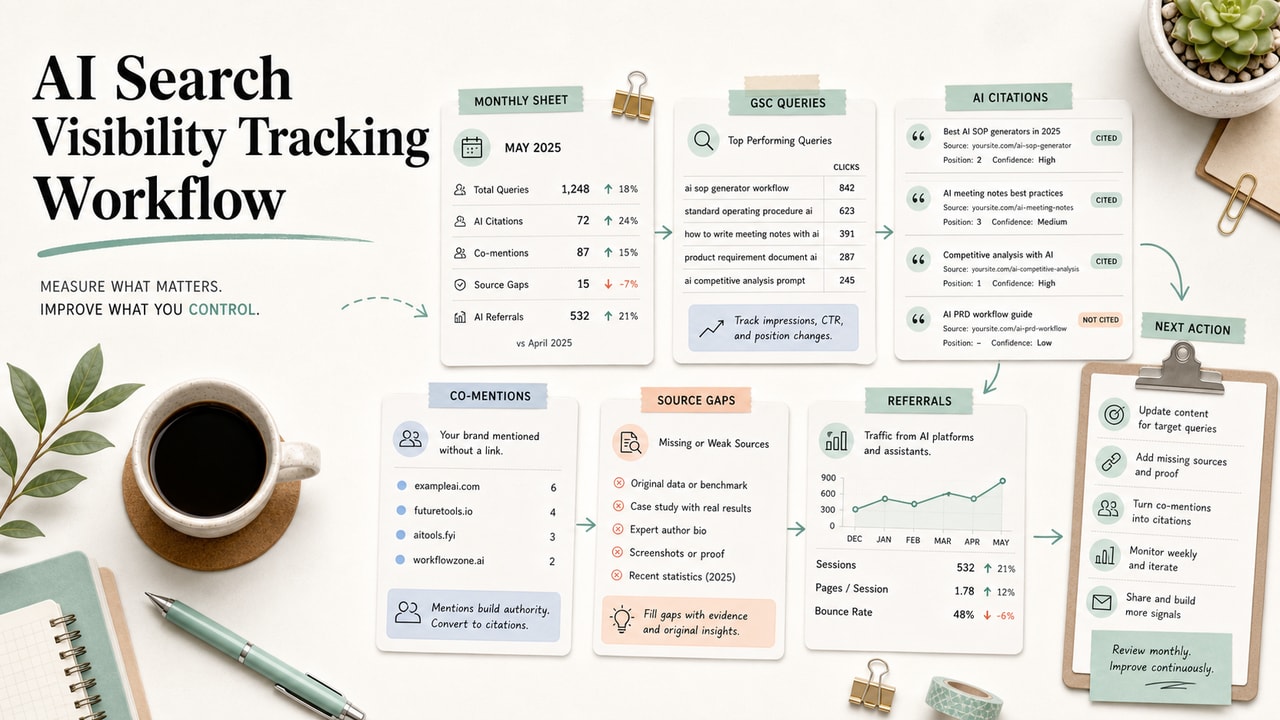
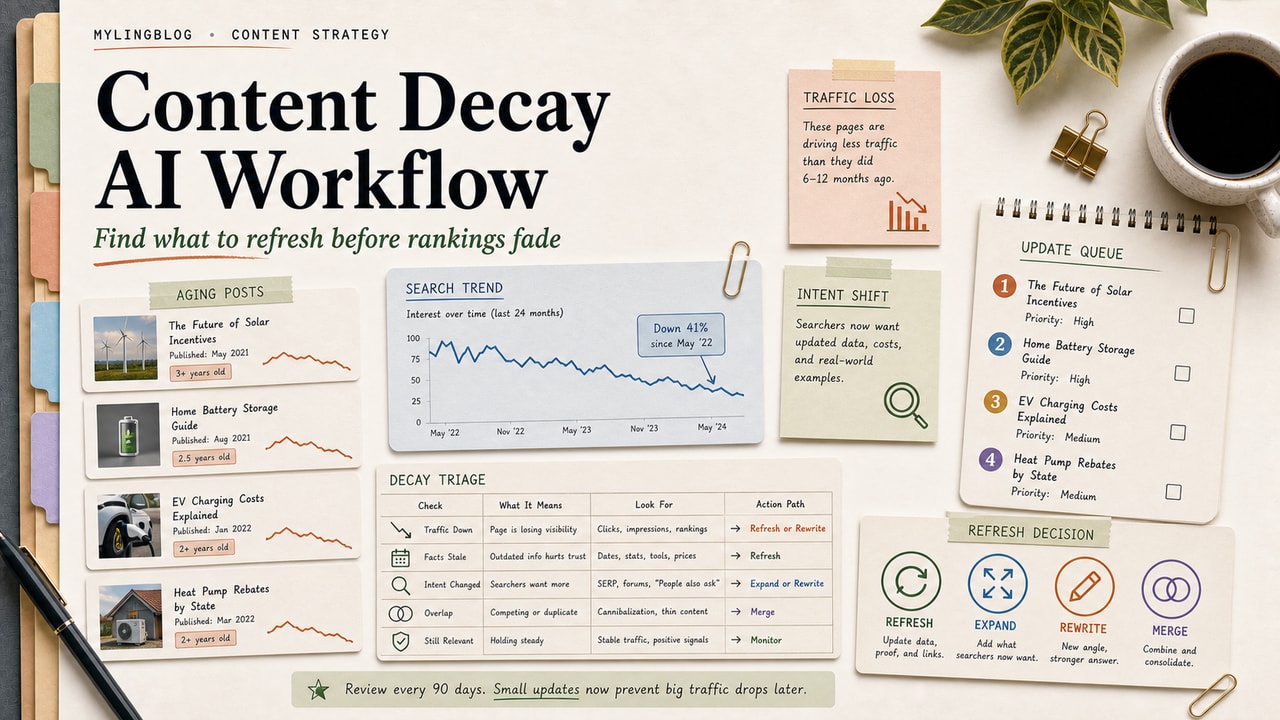
For a related recovery layer, use our content decay AI workflow when multiple pages are slipping. If the issue is AI-search measurement, pair this with our AI search visibility tracking workflow.
FAQ
Why is Reddit outranking my site in Google?
Reddit may outrank your site because the query needs recent opinions, edge cases, first-hand experience, or unresolved objections that your article does not answer. It can also happen when your page is too broad for a narrow pain query. Treat the Reddit result as intent evidence first, then verify whether your article lacks experience, freshness, specificity, or a better search-entry angle.
Should I create Reddit posts to win the SERP back?
Usually no. Ethical community participation can help you understand the reader's language, but fake posts, planted mentions, or vote manipulation are not a content strategy. If you join a discussion, do it as a real participant and answer the question directly. Your owned article should stand on its own with sources, examples, and a useful artifact.
How do I compete with forum results without copying them?
Compete by doing what forums cannot do cleanly: organize the messy objections, verify official facts, add a decision framework, and give the reader a next step. A forum thread often has texture but weak structure. Your article should keep the texture through workflow notes and pitfalls, then add a matrix, checklist, or source log that helps the reader act.
When should I stop chasing a Reddit-heavy keyword?
Stop chasing when every close query variation is discussion-first, the top results are fresh community threads, and your page cannot add first-hand evidence without inventing it. In that case, pivot to a narrower query, a comparison with a clear decision, or a practical checklist. A graceful pivot often protects more traffic than a forced rewrite.
Can AI search still cite my article if Reddit ranks first?
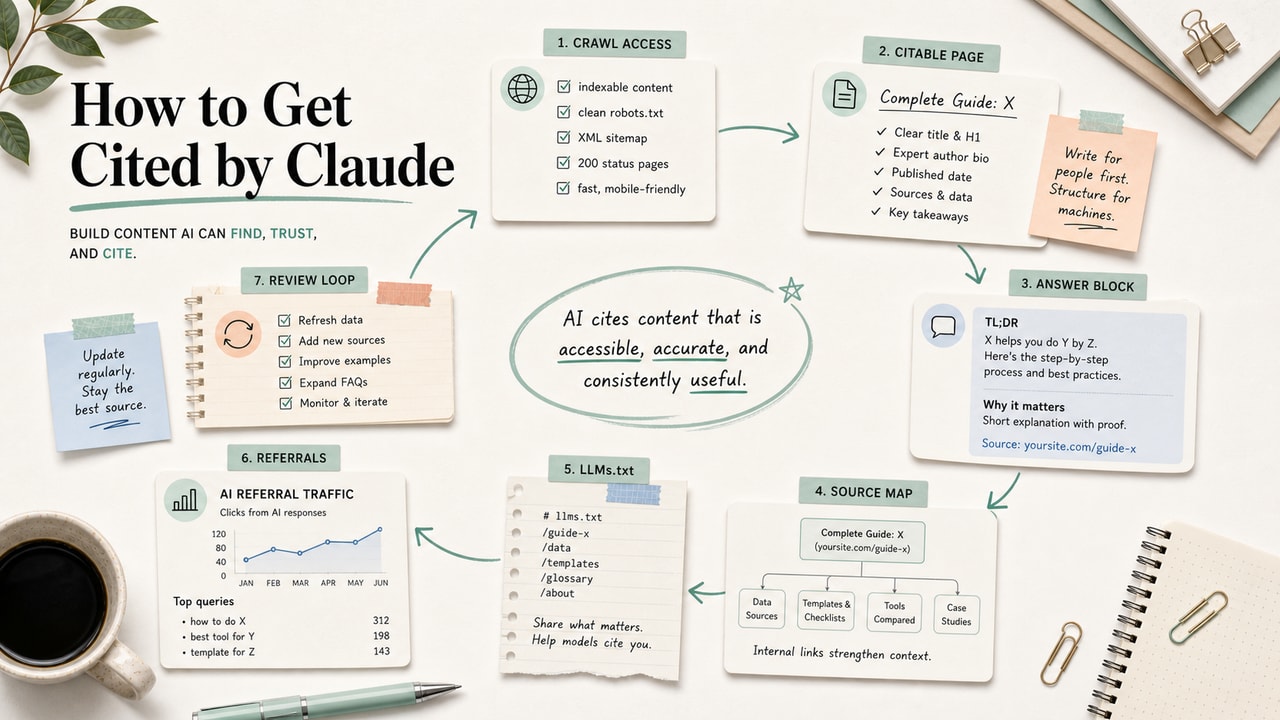
It can, but do not count on it. Google's AI-features guidance says AI experiences can use query fan-out and supporting links that vary from classic search. Your best chance is to publish clear text, source-backed claims, internal links, and an original artifact that answers a subquestion better than a thread. Visibility is not guaranteed, so track clicks and referrals after recrawl.
Final Recommendation
If Reddit is outranking your site, run a diagnosis before you rewrite. Choose a rewrite when your article is missing proof, choose a split when the forum query is narrower than your page, choose ethical participation when you can genuinely help, and choose a pivot when the SERP is discussion-first across the whole query set. The worst move is to imitate a thread while losing the structure that an independent site can provide.
For most MyLing-style workflow pages, the strongest repair is a new opening, one source log, one decision matrix, and a clearer related-workflow path. That gives readers a reason to stay after the quick answer.
Start with your top 10 declining queries, mark which ones are forum-heavy, and repair only the two where your article can add verified experience or a better decision tool.