 Lingye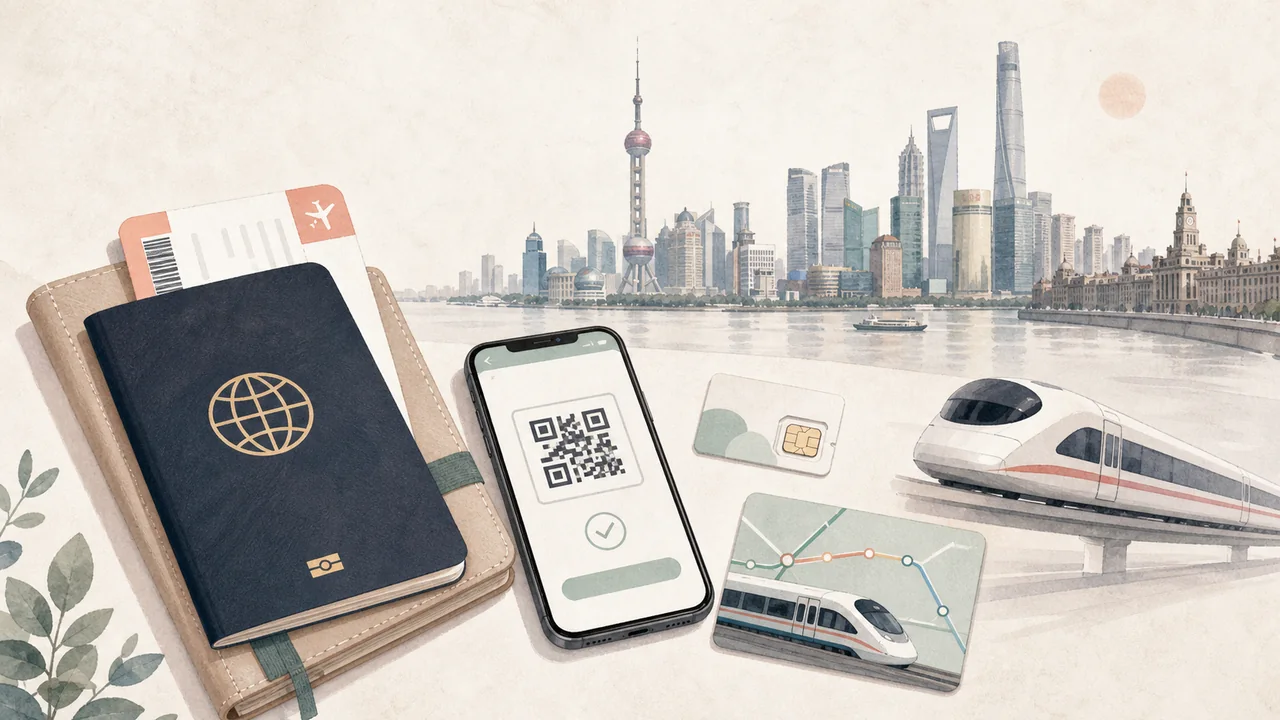
The first friend I helped land in Shanghai showed up with $400 in crisp US dollars, a paper map, and the firm belief that his phone would be a brick the moment he cleared customs. Within an hour he had paid for a taxi with a face scan, messaged his wife on a working WhatsApp, and asked me why nobody told him it would be this easy. Most of what Westerners "know" about visiting Shanghai is about five years out of date. This guide is the version I wish every first-timer arrived with.
Quick Answer
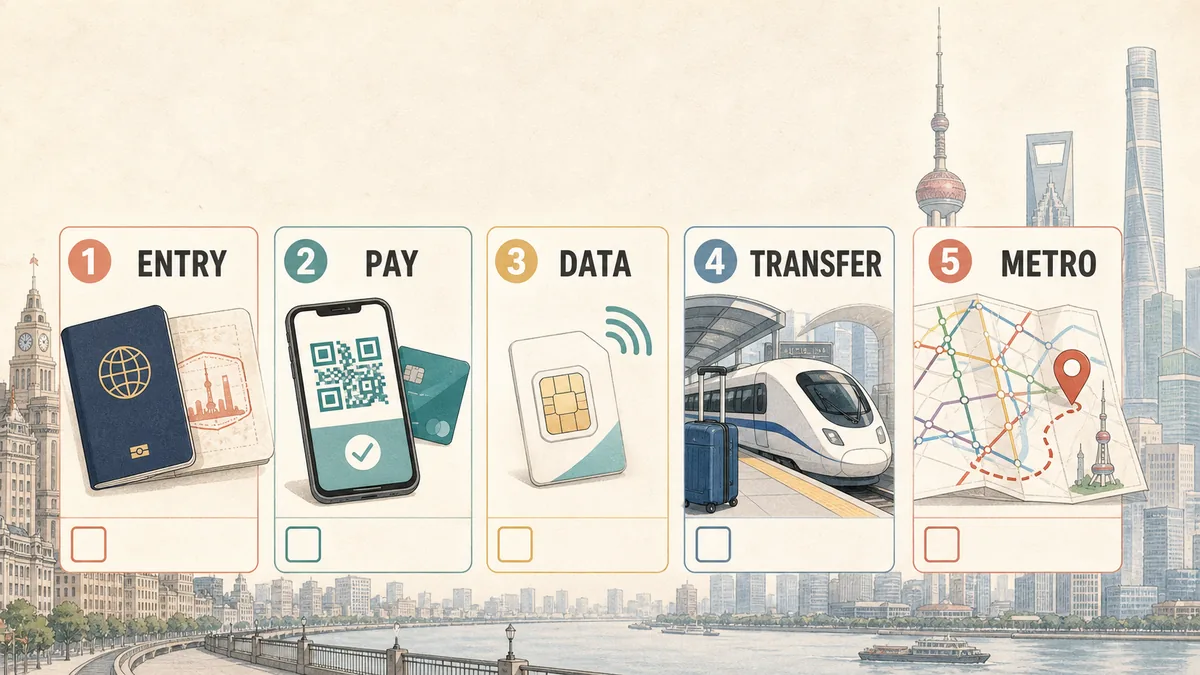
For a first-time Shanghai trip in 2026, the survival kit is short: set up Alipay or WeChat Pay with your Visa or Mastercard before you fly, install a China travel eSIM that routes around the firewall so Google and WhatsApp keep working, and sort your entry status — US citizens usually enter on the 240-hour visa-free transit rule or a regular L tourist visa. Shanghai is one of the easiest big Asian cities for a nervous first-timer: the metro is cheap and signed in English, almost nothing runs on cash anymore, and you rarely need to speak Mandarin to get through a day. This guide is for Western travelers spending three to seven days in the city. It is not a deep cultural-immersion plan or a budget-backpacker route — it is the practical "don't get stuck" baseline.
Quick Logistics Box
| Item | Reality in 2026 |
|---|---|
| Typical trip length | 3–5 days for the city; 5–7 with a day trip |
| Entry (US passport) | 240-hour visa-free transit (if onward to a third country) or 10-year L visa |
| Daily budget (mid-range) | ~US$90–160/day incl. mid-range hotel |
| Best seasons | Late March–May and September–early November |
| Money | Alipay / WeChat Pay (foreign card linked); cash as backup |
| Connectivity | Travel eSIM with firewall bypass; VPN for laptop on hotel Wi-Fi |
| Language need | Low — metro and ride apps work in English |
Pricing and rules are "as of June 2026, check official sources" — entry rules in particular change without much notice.
Who This Guide Is For
- Best for: First-time Western (US/Canada/EU) visitors doing a city trip, a stopover, or a business add-on.
- Also useful for: Nervous travelers who have heard Shanghai is "cash-free and cut off" and want to know what is actually true.
- Not ideal for: Long-term movers needing residence/work-permit detail, or backpackers optimizing for the absolute cheapest hostel route.
The Myths First-Timers Pack (And What's Actually True)
In my years living in Shanghai, the same five worries come up every single time a friend visits. Here is the honest version.
- "It's cash-only / cashless and I'll be stuck." Neither extreme is true. Shanghai is overwhelmingly mobile-pay, but since 2023 foreign Visa and Mastercard can be linked to Alipay and WeChat Pay, and major hotels still take physical cards. Carry a little cash for tiny street vendors; everything else is a QR code.
- "My phone won't work / I'll be totally offline." Your home apps (Google, Gmail, WhatsApp, Instagram) are blocked on local networks, but a China travel eSIM that routes internationally keeps them working as if you were home. The "great offline experience" people fear is a solved problem.
- "Nobody speaks English and I'll be lost." Shanghai is the most internationally legible city in mainland China. Metro signage, ticket machines, and ride-hailing apps all run in English. You will be fine with zero Mandarin, though a few phrases buy a lot of goodwill.
- "I need to book everything through an agency." You don't. Independent travel is straightforward here. Trains, attractions, and hotels are bookable on English-language apps.
- "It's intimidatingly huge." It is big — 25-plus million people — but the tourist core (the Bund, People's Square, the former French Concession, Pudong's skyline) is compact and metro-connected.
Money: How to Actually Pay in Shanghai
Here is the single most important prep step. Mobile payment in Shanghai works by linking your foreign card to Alipay or WeChat Pay; the apps convert and charge your card, so you scan a QR code instead of swiping. Set this up at home, on Wi-Fi, before you fly — binding a foreign card can trigger a verification check that takes anywhere from a few minutes to a day or two.
What to know before you rely on it:
- Both apps fully support international Visa and Mastercard for tourists as of 2026 — Alipay's own international guidance walks through the card-linking flow. You do not need a Chinese bank account or phone number.
- Verification got stricter in late 2025. Bind your card early in case it needs review.
- There is a small foreign-card fee. Alipay, for example, applies a service fee on international-card transactions above a low threshold, so very small purchases may be effectively free while larger ones carry a few percent.
- Daily and per-transaction caps exist (commonly up to ¥50,000/day for verified foreign cards) — far above what a normal trip needs.
- Backup plan: keep a Visa/Mastercard for hotels and a few hundred yuan in cash for the rare cash-only stall or a phone that dies. Never rely on a single payment method in any foreign country.
Connectivity: Staying Online Without a Battle
Shanghai's connectivity problem is not "no internet" — it is that your normal internet is blocked on local SIMs and hotel Wi-Fi. The clean fix is a China travel eSIM that routes your data through an international gateway, so Gmail, Google Maps, WhatsApp, and Instagram keep working on your phone with no extra setup.
How I'd handle it:
- Buy and install a China travel eSIM before you leave home (you need your home internet to activate it). Providers like Holafly, Airalo's China eSIM, and Saily sell China-specific plans that route around the firewall.
- Keep your home SIM for any two-factor SMS codes; use the eSIM for data.
- For your laptop on hotel Wi-Fi, the eSIM bypass does not apply — that traffic is on a local network. Install a reputable VPN at home before you travel — I've kept NordVPN pre-installed for exactly this — because VPN sites themselves can be hard to reach once you've arrived.
- Download offline Google Maps of Shanghai and any translation app before departure, as a belt-and-suspenders move.
One honest caveat: connectivity rules in China can shift, and no single tool is guaranteed forever. Carrying both an eSIM (for the phone) and a pre-installed VPN (for the laptop) is the resilient combination.
Getting In From the Airport
Shanghai has two airports. Pudong (PVG) handles most long-haul international arrivals; Hongqiao (SHA) is mostly domestic and regional. Most first-timers land at Pudong.
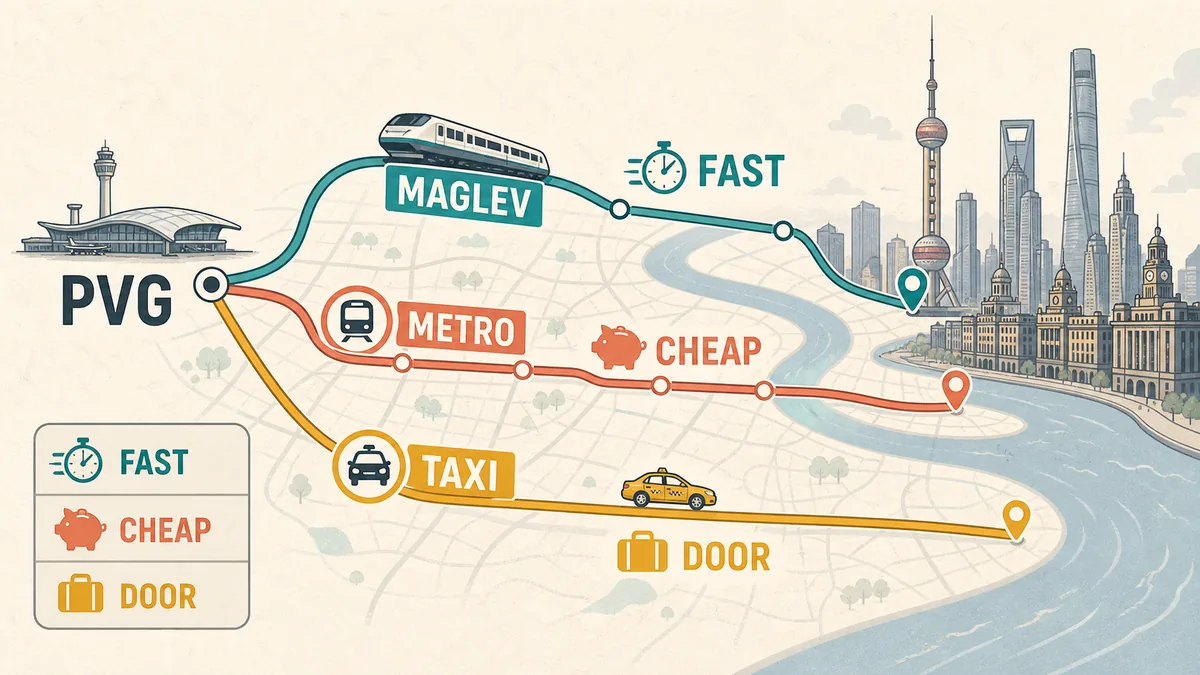
From Pudong, your options:
- Maglev + Metro. The Shanghai Maglev is the world's fastest commercial train and gets you most of the way into town in about eight minutes. A single economy trip is ¥50 (¥40 if you show a same-day flight ticket); a combined Maglev + Metro one-day pass runs around ¥55. You still transfer to Metro Line 2 to reach the center, but it is a genuinely fun first ride.
- Metro Line 2 directly. Cheapest option — single fares are roughly ¥3–8 depending on distance. Slower (the line is long) but it drops you near People's Square and the Bund.
- DiDi / taxi. DiDi (China's Uber) works in English and is the low-stress choice with luggage. Expect a longer ride and a higher fare than the train, but no transfers.
From Hongqiao, you're closer in and Metro Lines 2 and 10 reach the center easily.
Getting Around the City
- Metro is the backbone: clean, cheap (¥3–15 per ride), English-signed, and it reaches almost everything a visitor wants. Pay by linking your transit QR inside Alipay or WeChat — no separate card needed.
- DiDi for door-to-door, late nights, or rain. The app has an English mode and you pay in-app, so there's no language friction with a driver.
- Walking is underrated here. The Bund, the former French Concession's plane-tree streets, and the Xintiandi area are best on foot.
A Sensible First Three Days
This is the skeleton I give visiting friends — adjust to taste:
- Day 1 — Orientation. The Bund waterfront at dusk for the Pudong skyline, then walk into the former French Concession for dinner. Low effort, high payoff, beats jet lag.
- Day 2 — Old and new. Yu Garden and the old town in the morning, People's Square and a museum midday, then up a Pudong tower (or the riverside) for the view at night.
- Day 3 — Your Shanghai. Pick a lane: art and cafés in the Concession, shopping on Nanjing Road, or a half-day trip to a nearby water town like Zhujiajiao.
Budget Snapshot (Mid-Range Solo Traveler, Per Day)
| Category | Typical cost (USD) | Notes |
|---|---|---|
| Mid-range hotel | $55–110 | Central, 3–4 star; book ahead |
| Food | $15–35 | Mix of local spots and a nicer meal |
| Local transport | $3–8 | Metro + the occasional DiDi |
| Attractions | $5–20 | Many sights are cheap or free |
| eSIM data | ~$2–5/day | Amortized over the trip |
| Rough daily total | $90–160 | Excludes flights and big splurges |
Costs are approximate, as of June 2026 — check current prices when you book.
What Surprised Me (And What I'd Do Differently)
The thing that surprises nearly every first-timer is how frictionless daily logistics are once payment and data are set up — and how stuck you feel for the first hour if they are not. The single mistake I see most: people land, try to bind a foreign card to Alipay at the airport on a dodgy connection, the verification stalls, and they spend their first evening stressed instead of on the Bund. Do that setup at home.
The thing I underrated for years: just walking. Shanghai rewards aimless wandering more than almost any Asian megacity I know, because the old Concession streets are low-rise, shaded, and full of small surprises.
Pitfalls and Small Scams to Sidestep
- The "tea ceremony" and "art student" approaches near tourist spots (the Bund, Nanjing Road) end in a wildly inflated bill or a hard sell. A friendly stranger inviting you to a private tea tasting is the classic one. Politely decline and move on.
- Unofficial "taxis" at the airport. Use DiDi or the official taxi rank, never a tout.
- Setting up payment too late. Covered above — it's the number-one avoidable stress.
- Assuming hotel Wi-Fi will reach your apps. It won't, on its own. That's the eSIM/VPN job.
- Cash-only assumptions in either direction. Carry a little; rely on QR.
FAQ
Do I need a visa to visit Shanghai as a US citizen in 2026?
Usually one of two things. If you're transiting to a third country, you may qualify for 240-hour visa-free transit (administered by China's National Immigration Administration), which lets eligible travelers (including US passport holders) stay in designated regions for up to ten days without a visa, provided you have an onward ticket. For a standard round-trip tourist visit that isn't a transit, you'll generally need a regular L tourist visa. Rules change — confirm with the U.S. State Department's China information page and the Chinese consulate before booking. See my full breakdown linked below.
Can I use my phone normally in Shanghai?
Yes, if you prepare. On local SIMs and hotel Wi-Fi, apps like Google, Gmail, WhatsApp, and Instagram are blocked. A China travel eSIM that routes internationally keeps them working on your phone with no fiddling. For your laptop on hotel Wi-Fi, install a VPN before you travel. Set both up at home — some of these services are hard to download once you've arrived.
How do I pay for things if I don't have a Chinese bank account?
You link your foreign Visa or Mastercard to Alipay or WeChat Pay, and the app charges your card while you scan QR codes. No Chinese bank account or phone number is required as of 2026. Do the setup before you fly, since binding a foreign card can trigger a verification check. Keep a physical card and some cash as backup.
How many days do I need in Shanghai?
Three full days covers the headline city — the Bund, the old town, the French Concession, and a Pudong skyline view — at a comfortable pace. Add a day or two if you want a water-town day trip (Zhujiajiao), more museums, or a slower rhythm. For a transit stopover, even 36–48 hours gives you a real taste, especially if you stay central and lean on the metro.
Is Shanghai safe for a first-time solo traveler?
Shanghai is one of the safer big cities a first-timer can pick: violent crime against visitors is rare and the metro is safe late into the evening. The realistic risks are tourist-trap scams (the tea-ceremony and art-student approaches) and the logistical traps of unprepared payment and connectivity. Use official taxis or DiDi, keep your wits near the busiest tourist streets, and you'll be fine.
Final Recommendation
If you do only three things before flying to Shanghai, do these: link a foreign card to Alipay or WeChat Pay at home, buy a China travel eSIM that bypasses the firewall, and confirm your exact entry status for your trip type. Nail those and Shanghai goes from "intimidating megacity" to one of the smoothest first trips in Asia. Everything else — the Bund at dusk, the Concession streets, the maglev grin — is upside.
👉 Sort the two things that actually break first trips before you go: lock in a China travel eSIM so your apps work the moment you land, and book your central Shanghai hotel and airport transfer on Trip.com so day one is friction-free.
Some links in this article are affiliate links; they don't change my recommendation or your price.