
 Lingye
Every few weeks a friend forwards me a headline: "China is visa-free now — just book a flight." Then they ask why I'm still telling them to apply for a visa. The short version: those headlines are real, but they are almost never about a US passport. After ten years based in Shanghai and a long run of walking visiting friends through the border, I've watched Americans arrive at the check-in counter genuinely surprised that the "30-day visa-free" deal everyone is posting about does not include them. It is one of the most expensive misunderstandings in Asia travel right now, because the fix — when you catch it late — is a rushed consulate appointment and a changed flight.
Quick Answer
As of mid-2026, China is not visa-free for US citizens in the way the viral headlines suggest. The unilateral 30-day visa-free scheme covers around 45–50 countries (most of the EU, the UK, Canada, Australia, Japan, South Korea and several Latin American states) — the United States is not on that list. As an American you have two real paths: the 240-hour (10-day) visa-free transit, which works only if you are continuing onward to a third country or region and have the ticket to prove it; or a proper tourist (L) visa — usually the 10-year multiple-entry one — for an ordinary round trip from the US. This guide is for US passport holders planning a 2026 trip to mainland China; it is not for citizens of the visa-free countries, who can ignore most of it. Verify every date and fee on the official consulate page before you book, because these rules are running on temporary extensions.
Wait — Is China Actually Visa-Free for Americans in 2026?
No, not in the headline sense. Here is the confusion, untangled. China has spent the last two years aggressively opening up to tourism, and it has done so through three separate mechanisms that the internet keeps blurring into one:
- The unilateral 30-day visa-free policy — a country-by-country list that lets ordinary passport holders enter for tourism, business or family visits with no visa and no onward-ticket requirement. This is the one that generates the "China is visa-free now" posts. The US is not on it.
- The 240-hour visa-free transit — open to about 55 countries including the United States, but only for travelers passing through China to a third destination.
- The ordinary visa — what Americans still need for a normal there-and-back trip.
So when a British or Japanese friend tells you they flew into Shanghai with nothing but a passport, they are telling the truth — for their passport. Yours plays by different rules. The good news: the rules that do apply to you are more generous than they were a few years ago, and one of them gets you up to ten days on the ground with no visa at all, if your itinerary fits.
The 30-Day Visa-Free Scheme: Who It's Really For
China's 30-day visa-free entry was extended again and now runs through December 31, 2026, and the list of eligible countries has grown to roughly 45–50, with the UK and Canada among the more recent additions. Eligible travelers can stay up to 30 days for tourism, business, family visits or transit, the allowance cannot be extended or converted in-country, and crucially there is no requirement to hold an onward ticket.
The United States is conspicuously absent from this list, and that is unlikely to change on a tourist's timeline — it sits inside a broader, slower reciprocity conversation between the two governments. The practical takeaway is simple: if you are reading a "visa-free China" article that does not specifically confirm the US passport, assume it is not describing your situation. I have watched too many people screenshot a generic list, see "China — 30 days visa-free," and never notice that the fine print was a different country's flag.
Your Two Real Options as a US Passport Holder
Here is the whole decision in one table. Almost every American trip to mainland China resolves to one of these two rows.
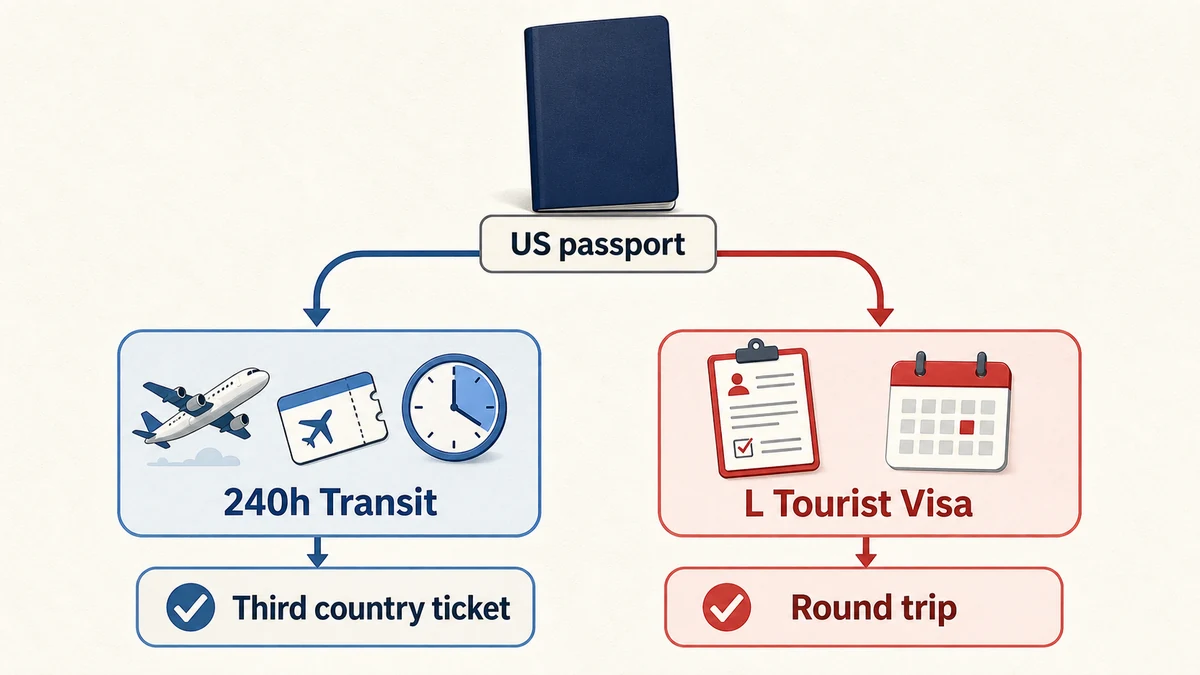
| Your situation | Use this | Max stay | The catch |
|---|---|---|---|
| Round trip from the US (e.g., LAX → Shanghai → LAX) | Tourist (L) visa | Up to 60 days per entry (10-year visa) | Apply in advance; ~US$140 fee; in-person appointment |
| Stopping in China en route to a third country (e.g., LAX → Shanghai → Seoul → LAX) | 240-hour visa-free transit | 10 days (240 hours) | Must show the onward ticket to a third country/region; region restrictions apply |
The fork is whether your journey continues to a genuinely different country or region after China. If it does, you may never need a visa. If you are flying in and back out to the US, you do.
Option 1: The 240-Hour Visa-Free Transit (the "almost visa-free" route)
This is the closest thing Americans have to visa-free China, and it is wildly underused because people don't realize they qualify. The transit allowance was extended from 144 to 240 hours (10 full days), the number of approved ports of entry rose to 65, and the policy now spans 24 provinces and municipalities — including Shanghai, Beijing, Guangzhou, Chengdu and Xi'an.
The non-negotiable rules
- You must be in genuine transit. You enter China, then continue to a third country or region. Hong Kong, Macau, Taiwan and anywhere outside mainland China count as a third region — so LAX → Shanghai → Hong Kong → LAX qualifies, while LAX → Shanghai → LAX does not.
- You need the onward ticket already booked, departing within 240 hours, and you'll show it at check-in and at immigration.
- Passport valid for at least 3 months.
- You stay inside the designated region you entered. The policy does not cover Xinjiang, Tibet, Inner Mongolia, Ningxia, Qinghai, Gansu or Jilin — don't plan a side trip there on transit status.
- The clock starts at 00:00 the day after you arrive — not at your landing time — which quietly gives you a few extra hours.
What actually happens at the border
- At your US departure airport, tell the airline you're using 240-hour visa-free transit; they confirm your onward ticket before boarding.
- On arrival, fill out the Temporary Entry Card for Foreign Nationals and join the foreigner/visa-free transit line at immigration.
- The officer checks your onward ticket and stamps you in. If you stay in a hotel, it registers your stay with the local police automatically at check-in — which is the main reason I tell first-timers to book a hotel rather than a homestay for a short trip; if you stay in a private home, you (or your host) must register at the local police station within 24 hours.
The first time I sent a visiting friend through this on a Shanghai → Tokyo connection, the only friction was the airline desk in the US not knowing their own policy — keep the rule from China's National Immigration Administration handy on your phone. On the China side it was faster than the regular visa line.
One more thing for a short transit stay: don't bother with a local SIM card. For 10 days, an eSIM you set up before you fly is far less hassle — and the right one solves the firewall at the same time. An Airalo China eSIM routes your data through servers outside the mainland, so Google, Gmail, WhatsApp and Maps work the moment you land, with no VPN needed on that connection. (Your hotel's WiFi is still behind the Great Firewall — that's what the VPN I mention below is for.) For a stopover where you won't be around long enough to want a physical SIM, it's the fastest way to stay online.
Option 2: The 10-Year L Tourist Visa (for a normal round trip)
If you're flying in and back out to the US, this is your route. The L (tourist) visa for Americans is typically issued as a 10-year, multiple-entry visa, with each individual stay capped (commonly up to 60 days). The fee for US applicants is around US$140 as of mid-2026 — a rate the consulates list as effective through December 31, 2026 — so confirm it on the official Chinese Visa Application Service Center page before you pay.
Two changes make this far less painful than its reputation:
- Since January 1, 2024, the Chinese consulates in the US no longer require flight bookings, hotel reservations or a day-by-day itinerary for a standard tourist visa application. You apply with your passport, the form and a photo.
- A fingerprinting exemption for certain short-term visas has been extended through December 31, 2026, which can shorten the process for eligible applicants — but eligibility shifts, so check whether it applies to you.
Standard processing runs about four business days once your application is accepted. You apply through the Chinese Visa Application Service Center (CVASC) that covers your state, and at least one in-person step is normally required for first-time applicants. Build in two to three weeks of buffer before departure; the appointment slots, not the processing, are usually what bottleneck people.
Entry Pitfalls I See Americans Trip Over
- Assuming the 30-day visa-free applies. The number-one mistake. The headline is real; the passport isn't yours.
- Booking a round trip and then hoping to use transit. A US → China → US ticket has no third country, so the 240-hour transit is off the table. If you want the transit route, deliberately build a third stop (Seoul, Tokyo, Bangkok, Hong Kong) into the booking.
- No proof of onward travel. Transit status lives or dies on that onward ticket. A vague plan is not a ticket.
- Wandering out of the designated region. Transit travelers occasionally try to tack on Tibet or a far-western leg — that's outside the policy.
- Skipping registration. Hotels handle it; private stays (a friend's apartment, some homestays) do not — that's on you, within 24 hours.
- Cutting the visa timeline too close. The processing is quick; the appointment availability is not. Treat it like booking a popular restaurant, not a same-day errand.
Before any China trip I also skim the US State Department's China information page — not because it changes the visa math, but because entry-and-exit notes and advisories there are the ones a US passport holder actually needs to know.
How I'd Plan It
If a friend texted me today, I'd ask one question: are you ending your trip in another country, or coming straight home? If they're continuing onward — say a two-week Asia loop with Shanghai and then Seoul — I'd point them straight at the 240-hour transit, no visa, and tell them to lock the onward leg first so the rest of the booking is clean. The onward ticket isn't just paperwork; it's the thing that unlocks the whole route, so I book it before anything else. I usually price the China-out flight to the third country on Trip.com, because its mainland coverage and same-day schedules tend to beat the US OTAs for routes like Shanghai–Seoul or Shanghai–Hong Kong.
If they're doing a classic round trip from the US, I tell them to just get the 10-year visa and stop overthinking it — the post-2024 application is genuinely light, and a 10-year multiple-entry stamp means the next trip costs them nothing but a flight.
One more thing I make every first-timer set up before they fly: a VPN. Many of the apps you lean on — Google, Gmail, WhatsApp, Instagram, your usual maps — are blocked behind the Great Firewall, and you can't download a working one once you're already inside China. I install something like NordVPN at home, test it on the actual network, and only then get on the plane. (An international eSIM like the Airalo one above already routes your cellular data around this — the VPN is for when you're on hotel WiFi.) It's the single most common "I wish someone had told me" I hear from visitors.
For a first visit, I'd budget like this:
| Item | 240-hour transit | 10-year L visa trip |
|---|---|---|
| Visa cost | $0 | ~US$140 (check official) |
| Lead time before flying | Just book the onward ticket | 2–3 weeks (appointment-limited) |
| Max time in China | 10 days | Up to 60 days/entry |
| Best for | City stopovers, Asia loops | Deeper trips, repeat visits |
FAQ
Do US citizens need a visa to visit China in 2026?
For a normal round trip from the US, yes — the United States is not part of China's unilateral 30-day visa-free scheme, so you need a tourist (L) visa, usually the 10-year multiple-entry one. The exception is the 240-hour visa-free transit, which lets you skip the visa if you're continuing to a third country or region within ten days and can show the onward ticket. Confirm current rules on the official consulate page before booking.
Can Americans use China's 30-day visa-free entry?
No. As of mid-2026 the 30-day visa-free list covers roughly 45–50 countries — much of Europe, the UK, Canada, Australia, Japan, South Korea and several Latin American states — and the US is not among them. The policy itself was extended through December 31, 2026, but that extension doesn't add the United States. If a list shows "China, 30 days," check whose passport it's describing; it almost certainly isn't the American one.
How does the 240-hour visa-free transit actually work for US passports?
You enter mainland China and continue to a third country or region within 240 hours (10 days), staying inside the region you entered through. You need a passport valid at least three months and a confirmed onward ticket. Hong Kong, Macau and Taiwan count as third regions, so a Shanghai-then-Hong Kong itinerary qualifies. The 240-hour clock starts at midnight the day after you arrive. It's the closest thing to visa-free China for Americans.
How much is the China tourist visa and how long does it take?
For US applicants the L visa fee is around US$140 as of mid-2026, a rate listed as effective through December 31, 2026 — verify it on the official page. Standard processing is about four business days after acceptance, but appointment availability at the visa center is usually the real constraint, so apply two to three weeks before you fly. Since 2024, you no longer need to submit flight or hotel bookings for a standard tourist application.
Does a round-trip US–China–US ticket qualify for visa-free transit?
No. Transit requires a third country or region after China, and a round trip back to the US doesn't have one. If you want to use the 240-hour transit, deliberately route through a third stop — for example fly home via Seoul, Tokyo, Bangkok or Hong Kong. Otherwise, get the tourist visa. This is the single most common reason Americans think they qualify for transit and then find out at check-in that they don't.
Final Recommendation
Match the route to your trip, not to the headlines. If you're looping through Asia and China is one stop, the 240-hour transit gives you ten days with no visa — just book the onward ticket first, because that's what makes the whole thing legal. If you're flying there and back, get the 10-year tourist visa; it's a light application now and it pays off for a decade. Either way, read the current rules on the official consulate page before you book, since the friendly fees and exemptions are running on extensions that expire at the end of 2026.
👉 Planning the route? Price your China-out leg — the onward flight that unlocks the 240-hour transit, or your round-trip into Shanghai — on Trip.com's Shanghai flight search, which tends to have the deepest mainland China schedules for exactly these routings.
Some links in this article are affiliate links; they don't change my recommendation or your price.