 Lingye
If your team set Claude Fable 5 as the model behind a coding agent, a research pipeline, or a content workflow this week, you opened it on the morning of 13 June and found it gone. The model did not break — it was switched off. The useful question now is not why; it is what you route to until it returns, with the least disruption to work that was already running.
Quick Answer
Claude Fable 5 is suspended for everyone as of 13 June 2026, after a US export-control order barred access for non-US nationals and Anthropic chose to disable both Fable 5 and Mythos 5 worldwide rather than filter users by nationality. Your Claude subscription and API key still work — only these two models are gone. For almost every workflow, the clean fallback is Claude Opus 4.8, which was the top model until Fable 5 launched and needs no prompt rewrite. Drop to Sonnet 4.6 for routine, cost-sensitive steps. If you call the API, swap the model ID from claude-fable-5 to claude-opus-4-8 and ship. This is a temporary, policy-driven outage with no announced end date, so build your fallback to be reversible, not permanent.
What Happened to Claude Fable 5
Fable 5 and Mythos 5 were pulled to comply with a US export-control order, not because of a model fault. On 12 June 2026 the US Commerce Department directed Anthropic to block access to its two most capable models for any non-US national, inside or outside the United States. Because Anthropic cannot reliably filter requests by nationality in real time, it disabled both models for all users while it appeals — a step it has described as a response to a misunderstanding it is working to resolve.
Two facts matter for planning. First, the scope is narrow: only Fable 5 and Mythos 5 are affected, and every other Claude model keeps working normally. Second, there is no published return date. Treat this as an outage you wait out, not a discontinuation you migrate away from for good. For the authoritative position, read Anthropic's own notice; for context, news coverage is available from outlets such as Al Jazeera. We are not lawyers, and export-control policy can change quickly — this article is about keeping your work moving, not interpreting the order.
Is Your Workflow Affected?
You are affected only if a workflow was specifically pinned to Fable 5 or Mythos 5; everything else is untouched. The fastest way to know is to check where you last selected a model: the app model picker, a saved agent config, or a hardcoded model ID in code.
| Where you use Claude | Affected? | What to do |
|---|---|---|
| Claude apps (web, desktop, mobile) | Only if Fable 5 was your default | Pick Opus 4.8 in the model selector; everything else is unchanged. |
API with claude-fable-5 | Yes — calls now fail | Change the model ID to claude-opus-4-8. |
| Coding agents / IDE tools set to Fable 5 | Yes | Switch the agent's model to Opus 4.8 in its settings. |
| GitHub Copilot, third-party apps | Only the Fable 5 option | Select another Claude model or provider default. |
| Workflows on Opus 4.8, Sonnet 4.6, Haiku 4.5 | No | Nothing — these models are unaffected. |
When we audited our own setups, the surprises were not in the chat apps — those switch back in one click. They were in two automations where a teammate had pinned claude-fable-5 in a config file weeks ago and forgotten. If a scheduled job has gone quiet since 12 June, that pinned ID is the first place to look.
What to Use Instead, by Task
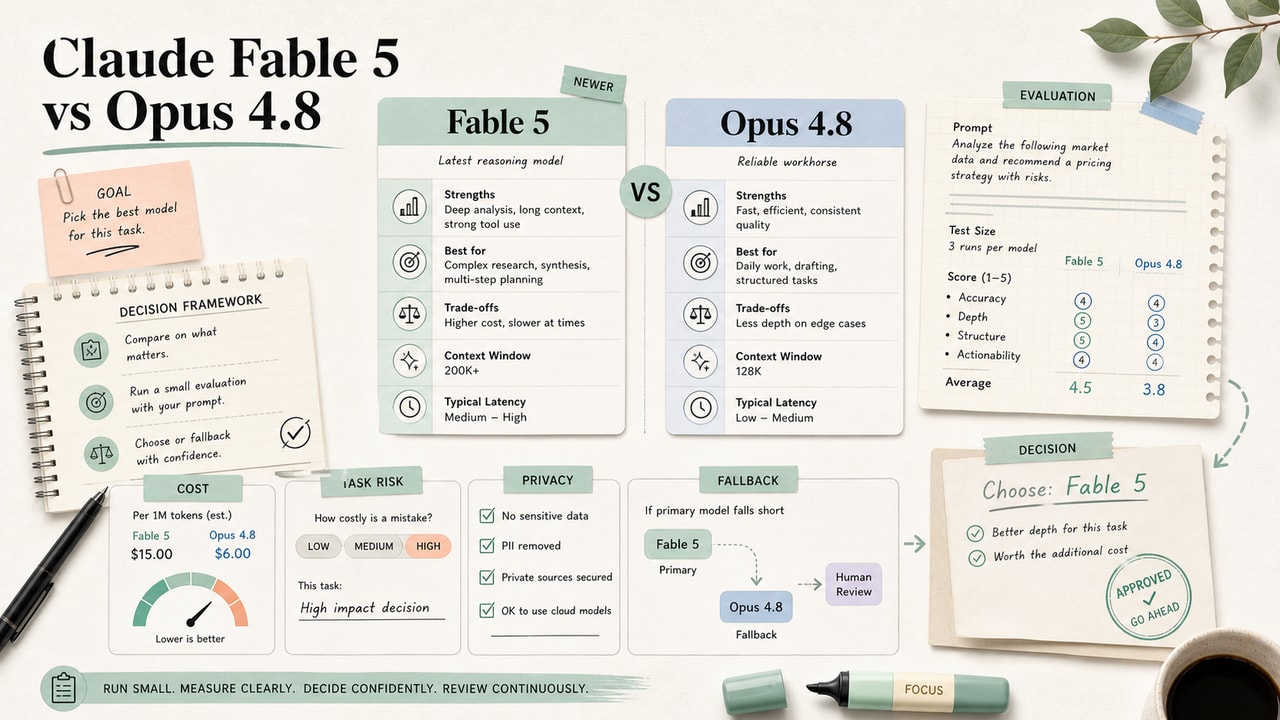
For most work the answer is Opus 4.8, with Sonnet 4.6 as the cheaper option for routine steps. Fable 5's edge showed up mainly on long-horizon, high-autonomy tasks; for everything shorter, you will struggle to see a quality drop after switching.
| Task | Fallback model | What changes in practice |
|---|---|---|
| Long codebase review or refactor | Opus 4.8 | Slightly more correction turns on very long runs; still strong. |
| Multi-document research | Opus 4.8 | Near-identical for most briefs; watch very long contexts. |
| PRD or strategy synthesis | Opus 4.8 | No practical change for typical inputs. |
| Routine drafting, summaries, tagging | Sonnet 4.6 | Lower cost, fast, fine for reviewable output. |
| High-volume, low-stakes calls | Haiku 4.5 | Cheapest; keep a human spot-check. |
| Work that truly needed frontier capability | Opus 4.8 now; revisit when Fable 5 returns | Accept a small ceiling drop until access is restored. |
If your stack already mixes providers, this is also the moment a second frontier model earns its keep as a backup — ChatGPT and Gemini are unaffected by this order — but you do not need to re-platform to keep working. Opus 4.8 covers the gap for nearly everyone.
Which fallback fits you: if a failed answer is expensive (shipping code, client research, a board memo), route to Opus 4.8. If a reviewer catches errors cheaply (internal drafts, tagging, summaries), route to Sonnet 4.6 and save the spend. If you only need Fable 5 for one or two genuinely frontier jobs, pause those and keep the rest running on Opus 4.8.
The Five-Minute Fallback Playbook
Switch defaults first, then hunt for pinned IDs, then add a guard so a future outage is a non-event. This is the order we ran it in, fastest payoff first.
- Change your app default. Open the Claude model picker and set Opus 4.8 as the default for your main workspace, so new chats stop pointing at a dead model.
- Find every hardcoded
claude-fable-5. Search your repos, agent configs, and environment variables for the stringfable-5. Replace each withclaude-opus-4-8. - Check scheduled jobs and webhooks. Anything that ran unattended since 12 June may have been failing silently. Re-run one manually to confirm it recovers.
- Handle the failure mode, not just the model. If your app called Fable 5, a request now returns an error. Make sure that path degrades to Opus 4.8 instead of surfacing a raw failure to users.
- Tell the team in one line. "Fable 5 is suspended; default is Opus 4.8 until further notice." That single message prevents a dozen "is Claude down?" pings.
Copy-and-Paste: A Model-Routing Fallback Rule
Drop this into your routing logic or agent config so an unavailable top model falls back automatically instead of breaking the run.
Primary model:    claude-opus-4-8        # was claude-fable-5 (suspended 12 Jun 2026)
Escalation model: claude-opus-4-8        # no higher tier available right now
Routine model:    claude-sonnet-4-6      # cost-sensitive, reviewable tasks
Bulk model:       claude-haiku-4-5       # high-volume, low-stakes

Rule:
- If a model ID returns "model not available", fall back one tier down,
  log the event, and continue — never surface a hard failure to the user.
- When Fable 5 is restored, set Primary back to claude-fable-5 and
  re-test the three workflows that most needed frontier quality.
If You Build on the Claude API
The only required change is the model ID; the request and response shape are the same. Replace claude-fable-5 with claude-opus-4-8 and your calls succeed again. While you are in the code, this is a good time to confirm two things many integrations skipped during the Fable 5 launch: that an unavailable-model error is caught and retried against a fallback, and that a response with stop_reason: "refusal" is treated as a normal state rather than a crash. Both make the next model change — including Fable 5's eventual return — a config edit instead of an incident. Check the current model list on the Anthropic models overview before you pin any ID.
Pitfalls We've Hit
- Assuming the apps and the API behave the same. The picker falls back gracefully; a hardcoded API ID just errors. The API is where the silent breakage lives.
- Treating the outage as a migration. Ripping out Claude entirely is a week of work to dodge a temporary block. Swapping to Opus 4.8 is five minutes and fully reversible.
- Forgetting the cost line moves. Opus 4.8 is cheaper per token than Fable 5 was, so some bills will drop — but a Sonnet-suitable task left on Opus is still overspend.
- Trusting "we can still get you Fable 5" offers. There is no legitimate workaround for an export-control block; the access sits on Anthropic's side, not behind a region setting.
How Long Will This Last?
There is no announced end date. Anthropic has said it is working to restore access and disagrees with the order's rationale, but it has not committed to a timeline, and the outcome depends on a government decision rather than an engineering fix. The honest planning stance: keep your fallback in place, do not budget around a return date, and re-test your frontier-dependent workflows only once Fable 5 actually reappears in the model list. Because this is a policy situation that can shift quickly, treat any specific "back by X" claim you see as rumor until it shows up in Anthropic's own notice.
FAQ
Can I use Claude Fable 5 right now?
No. As of 13 June 2026, Fable 5 and Mythos 5 are disabled for all users while Anthropic complies with a US export-control order issued on 12 June 2026. Every other Claude model still works, so the practical answer is to switch to Opus 4.8 and keep your workflow running.
What is the best replacement for Fable 5?
Opus 4.8 for nearly everyone — it was the most capable Claude model before Fable 5 and needs no prompt changes. Use Sonnet 4.6 for routine, cost-sensitive steps and Haiku 4.5 for high-volume work. Only tasks that genuinely needed frontier capability will feel a ceiling, and those are worth pausing until access returns.
Do I need to change my code or prompts?
Only the model ID. Swap claude-fable-5 for claude-opus-4-8 in API calls and agent configs; the request and response format is unchanged, so prompts carry over. If you have time, add a fallback for unavailable-model errors so the next change is a config edit, not an outage.
Is my Claude subscription still worth paying for?
Yes, in most cases. Your plan still includes Opus 4.8, Sonnet 4.6 and Haiku 4.5, which cover the large majority of real work. Only cancel if your entire reason for subscribing was frontier-only capability that nothing else can approximate — and even then, the suspension may be temporary.
Will switching to Opus 4.8 cost me more?
Usually less. Opus 4.8 is priced below what Fable 5 cost per token, so most bills fall after the switch. The trap is leaving routine tasks on a premium model: route reviewable, low-stakes steps to Sonnet 4.6 to keep spend matched to value.
Final Recommendation
Switch your default to Opus 4.8, replace any hardcoded claude-fable-5 IDs, and add a one-tier fallback so the next model change is a config edit rather than an incident. Keep the routing reversible: when Fable 5 returns, you want to flip one line and re-test, not rebuild. For the small set of jobs that truly needed frontier capability, pause and wait rather than over-engineering a workaround.
👉 Next step: if Claude is already your main model, the fastest move is to stay in the same place and drop to Opus 4.8 — open your Claude workspace, set Opus 4.8 as the default, and run your three most important workflows to confirm they recover. Then bookmark this page; we will update it the moment Fable 5 is back.
Some links in this article are affiliate links; they don't change our recommendation or your price.