 Lingye
The most common question I get after writing about chip stocks isn't "should I buy NVIDIA" — it's "which semiconductor ETF should I buy." And the honest answer is that the three names everyone lands on — SOXX, SMH and SOXL — are not three versions of the same thing. Two are reasonable long-term ways to own the chip cycle, and the third is a trading instrument that quietly bleeds value if you hold it. Picking between them is mostly about how concentrated a bet you want and whether you understand what daily leverage actually does.
I've spent fifteen years investing while living across Asia, where most of the companies inside these funds actually build their chips. After Micron's record quarter and a broad chip rally, a lot of people are reaching for a semiconductor ETF for the first time. This guide compares SOXX vs SMH vs SOXL on the things that actually matter — index, holdings, cost, concentration and structure — and gives you a simple way to choose, with no price targets.
SOXX vs SMH vs SOXL at a glance
Start here. These three trade like cousins but behave very differently, and the differences are structural, not cosmetic.
| Ticker | Issuer | What it is | Holdings | Expense ratio* | Best for |
|---|---|---|---|---|---|
| SMH | VanEck | The 25 largest US-listed chip names, market-cap weighted | ~25, NVIDIA-heavy, holds TSM + ASML | ~0.35% | A concentrated bet on the leaders |
| SOXX | iShares | ~30 chip names, more US-centric, more equipment weight | ~30, broader spread | ~0.34% | A broader read on the whole cycle |
| SOXL | Direxion | 3x daily leverage on the index SOXX tracks | Derivatives, resets daily | ~0.75% | Short-term trades only — not a hold |
*Expense ratios are as of mid-2026 — verify each on the issuer's own page before buying, because they change. The one-line version: SMH is the sharp bet, SOXX is the broad one, and SOXL is a different animal entirely.
SMH: the concentrated bet on the leaders
VanEck's SMH tracks the MVIS US Listed Semiconductor 25 index — the 25 biggest US-listed chip companies, weighted by size. In practice that means it leans hard on the giants: NVIDIA alone has run near a fifth of the entire fund, with Broadcom, AMD and the big equipment names behind it. If you believe the chip leaders keep leading, SMH is the cleanest way to express that.
The detail most people miss is that SMH is quietly the most international of the two big funds. Its top positions usually include Taiwan Semiconductor (TSM) and ASML — a Taiwanese foundry and a Dutch lithography maker — so you get real exposure to the manufacturing chokepoints I write about, not just US designers. The trade-off is concentration: when NVIDIA has a bad week, SMH feels it more than a broader fund would.
SOXX: the broader read on the cycle
iShares' SOXX tracks the ICE Semiconductor index and holds around 30 names, with meaningfully more weight in semiconductor equipment and a more US-centric tilt. It owns the same core leaders, but it spreads the bet wider and leans less on any single stock. In a broad chip rally, a more balanced fund like SOXX can actually outrun the concentrated one, because mid-cap names rally faster off a lower base.
That cuts both ways. In a run led specifically by one or two megacaps, SMH's concentration wins; in a broad sector melt-up, SOXX's spread tends to win. Neither is "better" in the abstract — they're bets on different shapes of the same rally. The fees are effectively a tie, so cost shouldn't decide it.
SOXL: why a 3x ETF is a trade, not an investment
This is the one I stop people on. Direxion's SOXL aims for three times the daily move of the index SOXX tracks. On a green day it feels incredible. The problem is the word "daily": the leverage resets every single day, and over a choppy or sideways stretch that daily reset creates volatility decay — the fund can grind lower even if the underlying index finishes roughly flat.
A 3x daily ETF is built to be held for hours or days, not years. Over a long, choppy period it can lag the very index it's levered to. That isn't a bug — it's how the product is designed.
Used as a short-term tactical trade by someone who understands the math, SOXL is a tool. Bought as a "more aggressive way to own chips for the long run," it's a slow leak with a higher fee (around 0.75%). If that paragraph is the first time you're hearing the word decay, that alone is the answer: this isn't your fund.
The cheaper and equal-weight alternatives
SOXX and SMH aren't the only two. Two alternatives are worth knowing because they fix specific complaints:
- SOXQ (Invesco) tracks the PHLX Semiconductor index for a much lower fee — around 0.19% versus ~0.35%. For a long-term holder, that cost gap compounds. The trade-off is lower assets and liquidity than SOXX, so spreads can be a touch wider.
- XSD (SPDR) runs an equal-weight index: it resets every holding to roughly the same size each quarter, which pulls weight away from the megacaps and gives smaller chip names a bigger voice. If your real worry is "I don't want a third of my money in NVIDIA," XSD is the structural answer.
How concentration actually changes your returns
The single most useful lens here isn't fees — it's overlap and concentration. All of these funds share the same core, so the real question is how much of your outcome rides on the top few names. SMH puts more of your money in the leaders; SOXX spreads it; XSD deliberately flattens it. The more concentrated the fund, the more your return is really a bet on NVIDIA and a handful of others — whether or not that's what you thought you were buying.
This matters most if you also own chip stocks directly. If you hold NVIDIA shares and then buy SMH, you've doubled down on NVIDIA without noticing. I've watched people build what they thought was a diversified chip sleeve that was, in reality, the same megacap bet stacked three times. Check the top holdings before you add a fund to a portfolio that already leans that way.
How to choose — a simple decision
Strip it down to four questions and the choice usually makes itself:
- Do you want a sharp bet on the leaders, or a broad read on the cycle? Leaders → SMH. Broad → SOXX.
- Is your top worry too much NVIDIA? Then equal-weight XSD, or the broader SOXX, over SMH.
- Is the lowest possible fee the priority for a long hold? Look hard at SOXQ.
- Are you trying to trade a short-term move with leverage? Only then is SOXL even a candidate — and only for a defined, short holding period.
For most long-term investors who simply want chip exposure and don't want to think about it daily, SOXX or SMH is the honest answer, and the choice between them is a matter of taste, not a mistake either way.
How to actually buy one
The mechanics are boring, which is the point. All of these are US-listed, so you buy them in dollars through any standard US brokerage — search the ticker, check the issuer's page for the current holdings and fee, decide your size, and use a limit order. If you're investing from outside the US, the same funds are reachable through international brokers, with currency conversion as your main added cost. For the Asia-from-the-US angle on regional funds, see my guide to buying Asia ETFs from the US.
This is educational, not personalized financial advice. I'm not a financial advisor, I don't know your situation, and naming a fund here is not a recommendation to buy it. ETFs can lose value, leveraged ETFs especially so, past performance doesn't predict the future, and you should verify every holding and fee on the issuer's own page and consider a licensed professional before investing.
Pitfalls I've watched people hit
- Buying SOXL as a long-term hold. The decay is real. A 3x daily fund is a trade, full stop.
- Double-owning the leaders. A chip ETF plus the same chip stock plus a broad tech fund can be one bet wearing three tickers.
- Performance-chasing after a huge run. Whichever fund just went up the most is the one that feels safest and is often the most fully priced.
- Ignoring concentration until it hurts. A "diversified" semiconductor ETF can still be a near-single-stock bet at the top. Read the top ten holdings once.
FAQ
Is SOXX or SMH the better semiconductor ETF?
Neither is universally better — they're different shapes of the same bet. SMH is more concentrated in the largest chip leaders and is more international (it holds TSM and ASML near the top), so it does best when the megacaps lead. SOXX is broader, with around 30 names and more equipment exposure, so it tends to do better in a wide sector rally. Their fees are effectively tied, so choose by how concentrated a bet you actually want and check the current top holdings on each issuer's page.
Is SOXL a good long-term investment?
No. SOXL is a 3x daily leveraged fund, designed to multiply a single day's move, and its daily reset causes volatility decay that can erode value over time even if the underlying index is roughly flat. It has historically lagged the unleveraged index over long, choppy periods, and it carries a higher fee. It's a short-term tactical trading tool for people who understand the mechanics, not a buy-and-hold investment.
What's the cheapest semiconductor ETF?
Among the well-known options, SOXQ from Invesco has charged a notably lower fee — around 0.19% versus roughly 0.35% for SOXX and SMH — while tracking a similar semiconductor index. For a long-term holder, that lower cost compounds in your favor. The trade-off is smaller assets and liquidity than SOXX, which can mean slightly wider bid-ask spreads. Always confirm the current expense ratio on the issuer's page before buying.
Do SMH and SOXX hold TSMC and ASML?
SMH typically holds both Taiwan Semiconductor (TSM) and ASML near the top of its portfolio, which is why it gives you more direct exposure to the manufacturing and equipment chokepoints of the chip chain. SOXX is more US-centric, with TSM as a smaller position and less ASML weight at the top. If owning the Taiwanese foundry and the Dutch lithography leader matters to you, SMH is the more international of the two — but verify current holdings, which drift.
Which semiconductor ETF is best for AI exposure?
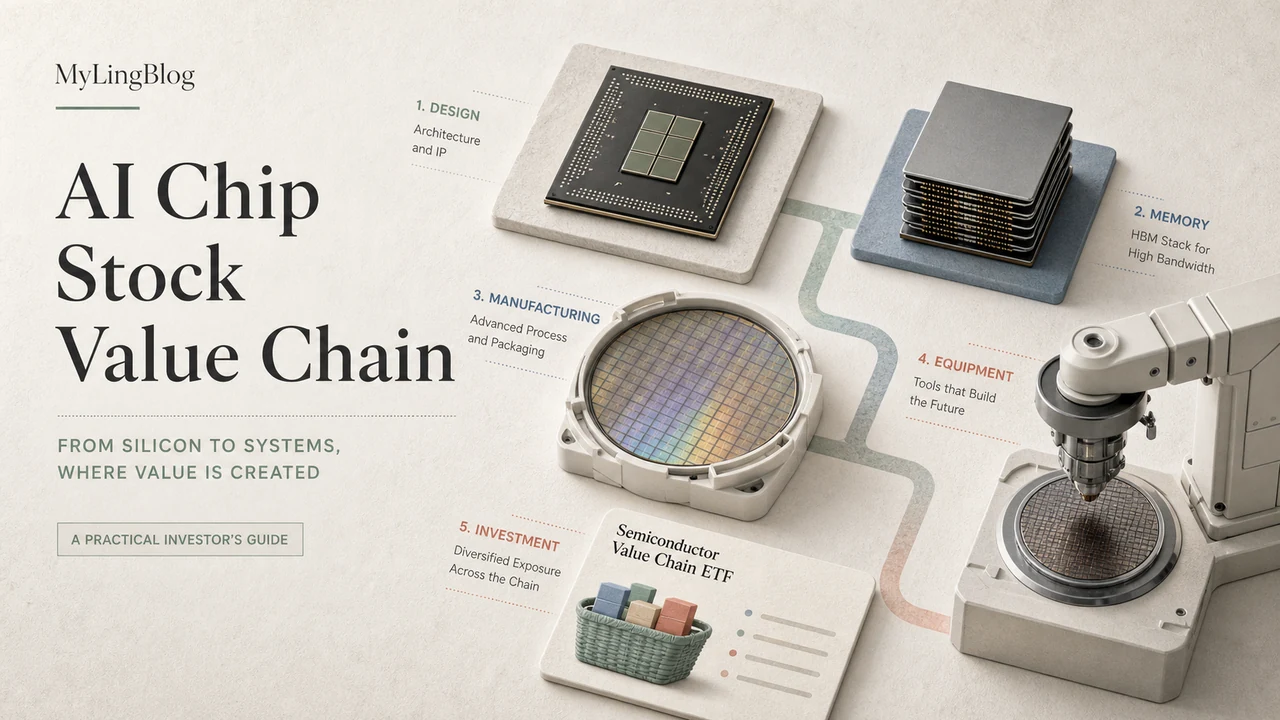
There's no single "AI chip ETF," because the AI buildout runs across the whole chain — designers, memory, foundry and equipment. A broad fund like SOXX gives you all four layers; a concentrated one like SMH tilts harder toward the AI-accelerator leaders and the foundry. If you want the full chain rather than a bet on a few names, lean broad or equal-weight. I map those layers out in my guide to the AI chip stocks that actually matter.
The bottom line
SOXX vs SMH is a genuine choice between a broad read on the chip cycle and a concentrated bet on its leaders, with fees too close to matter — pick by the shape of the bet you want. SOXL is not a third option in that conversation; it's a short-term trading tool whose daily-reset decay makes it a poor long-term hold. And if your real concern is too much megacap concentration, the cheaper SOXQ or the equal-weight XSD deserve a look. The funds are simple; the discipline is knowing which bet you're actually making.
For the bigger picture on what's inside these funds, read my map of the AI chip value chain and my breakdown of what moves Micron and the memory layer. Browse more in my Smart Money and Asia Markets coverage.